

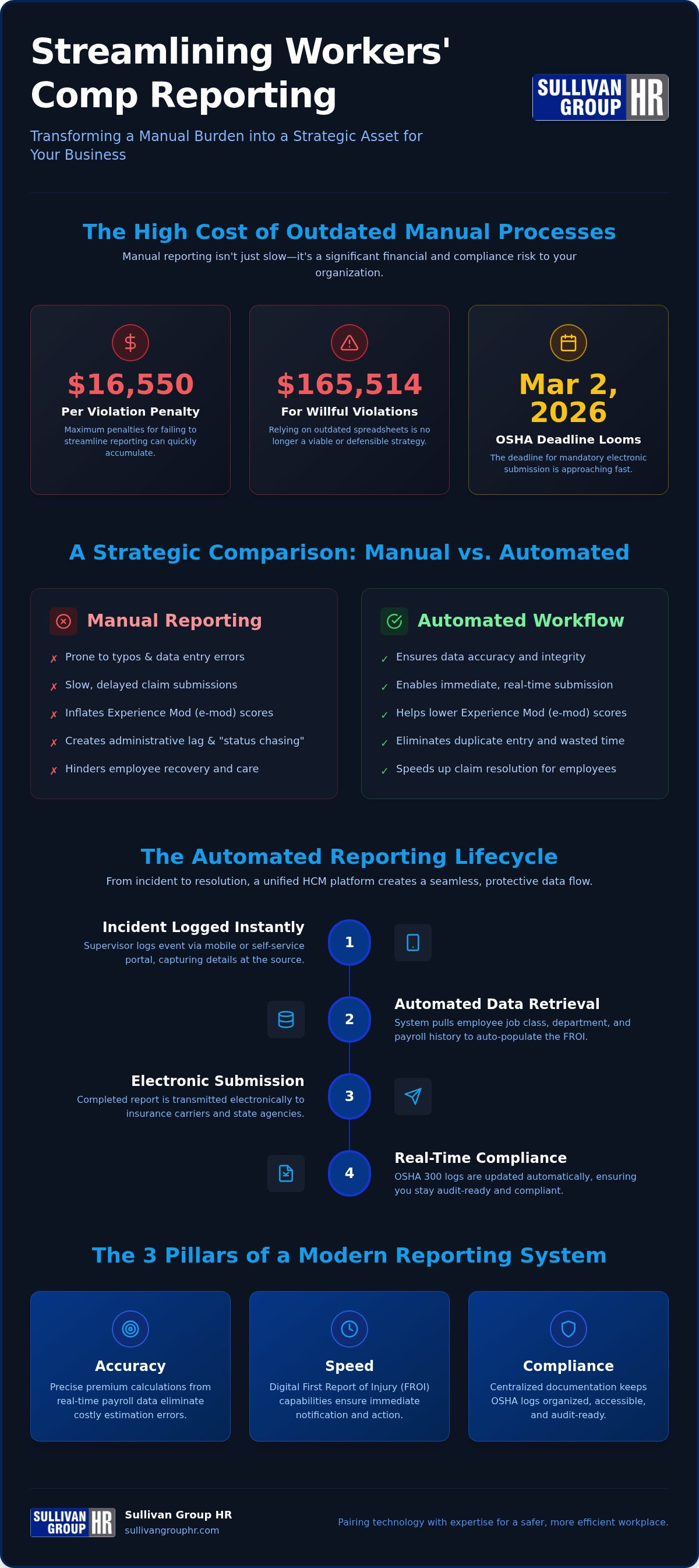
Is your workers' compensation process acting as a silent drain on your company's growth? Many business owners find themselves buried in manual data entry, only to be met with premium hikes and maximum penalties of $16,550 per violation when they fail to streamline workers comp reporting. You want to focus on your team's success, not on the stress of a looming March 2, 2026, OSHA electronic submission deadline. It's frustrating to feel like your administrative burden is standing in the way of your professional potential.
We understand that you need a partner who values people over systems. This strategic guide will show you how to transform your reporting from a manual chore into a seamless, automated HR function. You'll discover how to integrate payroll data with insurance reporting to reduce administrative overhead, lower your experience mod scores, and ensure faster claim resolution. We'll explore how a unified HCM platform provides the safety, security, and results your business deserves as you work to protect your bottom line.
Key Takeaways
- Move from reactive crisis management to a proactive data flow that synchronizes payroll, people, and incident records automatically.
- Learn how integrated HCM platforms eliminate duplicate entry and automate the reporting lifecycle from injury to carrier notification.
- Discover how to streamline workers comp reporting to improve accuracy, ensure compliance, and lower your experience mod scores.
- Focus on the human element by training supervisors on digital intake tools that support a proactive "Safety First" workplace culture.
- Bridge the gap between technology and expertise by pairing the isolved platform with a dedicated human resources risk consultant.
What is Streamlined Workers' Comp Reporting?
Do you feel like you're constantly playing catch-up with your insurance carrier? To truly streamline workers comp reporting, you must move beyond the idea of simply filling out forms faster. True streamlining is the automated synchronization of payroll, employee, and incident data into a single, cohesive workflow. It's a fundamental shift in how you handle What is Workers' Compensation within your organization. Instead of a reactive scramble after a crisis, your business adopts a proactive, continuous data flow that stays ahead of regulatory requirements.
This modern approach rests on three critical pillars: Accuracy, Speed, and Compliance. When these elements work together, they transform a complex administrative burden into a reliable asset for your business. Streamlined workers’ comp reporting is a unified digital process that connects your payroll, employee, and incident data to reduce corporate liability through immediate, error-free communication.
The Core Components of a Modern Reporting System
A high-performing system doesn't rely on memory or paper trails. It utilizes digital First Report of Injury (FROI) capabilities to capture details at the source. This ensures that the moment an incident occurs, the right people are notified without delay. Real-time payroll data integration is equally vital; it allows for precise premium calculations based on actual earnings rather than outdated estimates. Finally, centralized documentation for OSHA compliance logs keeps you audit-ready at all times. You won't have to go hunting for records because they're already organized and accessible.
Why Traditional Manual Methods Fail in 2026
Manual methods are more than just slow; they're expensive. The hidden cost of "status chasing" and administrative lag can quietly erode your profit margins. When data is entered by hand, the risk of "experience mod" (e-mod) errors skyrockets. A single typo can lead to years of inflated premiums that are difficult to correct after the fact.
Delayed reporting also has a direct impact on the human side of your business. It stalls the claim process, which can slow down an employee's recovery and increase the overall cost of the claim. In a world where maximum penalties for willful violations can reach $165,514, relying on a spreadsheet is no longer a viable strategy. It's time to trade the uncertainty of manual entry for the security of an integrated, automated solution that protects both your people and your bottom line.
How Integrated HCM Platforms Automate the Reporting Lifecycle
Why wait for a paper trail to catch up with a real-world emergency? When you use a unified platform, the reporting lifecycle begins the moment an incident is recorded. This digital integration is the only way to truly streamline workers comp reporting while maintaining absolute data integrity. By connecting your payroll, time tracking, and insurance data, you create a seamless loop that protects your business from administrative errors and legal delays.
Step-by-Step: The Automated Reporting Workflow
Imagine an incident occurs on the shop floor. Instead of hunting for a paper form or a lost PDF, the supervisor logs the event immediately through a mobile employee self-service portal. This triggers a sequence of automated events designed to protect your interests:
- Data Retrieval: The system automatically pulls the employee's job classification, department, and recent payroll history to populate the First Report of Injury.
- Electronic Submission: The completed report is electronically transmitted to your insurance carrier and relevant state agencies without manual intervention.
- Compliance Update: Your OSHA 300 logs are updated in real-time, ensuring you stay ahead of the March 2, 2026, electronic submission deadline.
This workflow relies heavily on accurate time and attendance tracking. Verifying exactly when an employee clocked in and out provides the objective evidence needed to validate claims and comply with the standards set by federal workers' compensation programs. It removes the guesswork and replaces it with verifiable data.
The Power of the isolved People Cloud
The isolved People Cloud serves as your single source of truth for all workforce data. By linking integrated HR and payroll software directly to your risk management strategy, you eliminate the need for duplicate data entry. This centralized approach creates a protective shield around your organization. You gain access to real-time dashboards that monitor claim trends, safety performance, and experience mod impacts. It’s about having the right information at the right time to make informed decisions for your team.
One of the most significant benefits of this automation is the "Pay-as-you-go" model. Traditional workers' comp often requires large upfront deposits based on estimated payroll. With integrated reporting, your premiums are calculated based on actual, real-time payroll data. This eliminates the "audit shock" at the end of the year and keeps your cash flow predictable and steady. If you're tired of chasing paperwork and want to focus on growth, Sullivan Group HR can help you build a more resilient workforce management system.
Manual vs. Automated Reporting: A Strategic Comparison
Are you still relying on a spreadsheet to manage your most sensitive employee data? For many, the choice between manual and automated systems feels like a matter of preference, but it's actually a matter of protection. To streamline workers comp reporting effectively, you must understand how automation transforms your risk profile. Manual entry isn't just slow; it's a liability that leaves you vulnerable to "audit shock" and inflated premiums. When you move to an integrated HCM, you trade administrative lag for real-time accuracy.
Data Integrity and Premium Accuracy
Misclassified employees are one of the leading causes of massive audit adjustments. When you use manual spreadsheets, it's easy for a worker to be filed under an incorrect class code. This oversight leads to a painful reconciliation at the end of the year. Integrated HCM systems use automated payroll mapping to ensure every employee is tied to the correct classification from day one. This level of precision is essential for modern HR risk management. It removes the "surprise" factor from your annual insurance renewals and keeps your financial planning on track.
The Speed Advantage: Impact on Claim Outcomes
Speed is the most significant differentiator in claim resolution. There's a direct correlation between reporting speed and the total cost of a claim. According to Workers' Compensation data and trends, early intervention significantly reduces long-term disability costs. When an incident is logged through an automated system, alerts reach adjusters within hours, not days. This allows medical care to begin immediately, which is better for the employee and your bottom line.
Manual workflows often suffer from "status chasing" where managers spend hours trying to find out where a report sits in the pipeline. Automation provides a transparent, fast communication channel that improves the employee experience. Your team feels cared for, and you stay compliant with state-mandated timelines. By choosing automation, you aren't just saving time; you're building a culture of reliability and safety that protects your professional potential. This proactive stance ensures you're always audit-ready, regardless of when a regulatory body comes calling.
Best Practices for Implementing Streamlined Reporting
Technology provides the framework, but your people drive the results. To effectively streamline workers comp reporting, you must bridge the gap between digital tools and human action. This isn't just about software; it's about a fundamental alignment with your broader human capital management strategy. When your team understands the "why" behind the process, compliance becomes a shared goal rather than a chore. Success requires a blend of clear protocols and a culture that values safety as much as productivity.
Standardizing Digital Incident Intake
Consistency is the enemy of error. Are your supervisors using the same process every time an injury occurs? You should establish a uniform digital intake form that everyone follows without exception. By utilizing mobile technology, your team can report incidents directly from the job site. This eliminates the delay of walking back to a desk or waiting until the end of a shift. Setting clear internal KPIs, such as a two-hour reporting window from the time of injury, ensures that your data remains fresh and your insurance carrier is notified immediately. This speed is your best defense against litigation and rising claim costs.
Leveraging Data for Loss Control
What happens after the report is filed? If you only use reporting for compliance, you're missing half the value. You should use reporting analytics to identify high-risk departments or specific shifts that see more frequent incidents. Turning these reports into "lessons learned" allows you to update safety training and prevent future injuries before they happen. It's about building a "Safety First" culture that protects your professional potential. Collaborating with a human resources management services partner can help you refine these policies based on industry benchmarks and regional trends.
Finally, don't overlook data hygiene. Your HCM platform is only as good as the information you put into it. Regular audits of your employee records, job codes, and contact information ensure that when an emergency happens, the system works perfectly. This proactive maintenance prevents the "audit shock" mentioned earlier in this guide. If you're ready to move away from reactive administrative burdens and toward a proactive safety strategy, Sullivan Group HR is here to guide your implementation every step of the way.
Elevating Your Risk Strategy with Sullivan Group HR
What would you do with the hours currently lost to administrative chaos? True organizational security requires more than just a login to a software platform. It requires a partner who stands with you in the trenches of risk management. Sullivan Group HR acts as the vital bridge between advanced technology and human expertise. We help you streamline workers comp reporting by combining the power of the isolved platform with the wisdom of an established national expert. It's about moving from a transactional vendor relationship to an empathetic partnership that values your team's safety as much as you do.
Our approach is built on three essential pillars: safety, security, and success. We provide a unified solution that integrates HR, Payroll, and Workers' Comp into a single, reliable workflow. This integration delivers a level of peace of mind that automated, tech-only competitors simply can't match. You gain the stability of a firm with a long-standing legacy of national service, ensuring your business remains protected regardless of changing regulations or territory nuances.
Beyond Software: The Fractional HR Advantage
Data is only useful if you know how to interpret it. While the isolved platform provides the numbers, our dedicated risk consultants provide the strategy. We help you look behind the dashboard to understand the "why" of your claim trends. Does a specific department need updated ergonomic training? Is there a recurring safety gap during the night shift? We help you customize the platform to address your specific industry risks. This fractional HR model gives you access to high-level expertise without the cost of a full-time executive. It's a "no-nonsense" way to build a more resilient organization.
Getting Started: The Path to Streamlined Operations
Ready to reclaim your time? The journey to streamline workers comp reporting begins with a comprehensive risk assessment and data audit. We look for the hidden errors in your current records that could lead to premium hikes or audit penalties. Once your data is clean, we handle the seamless onboarding onto the isolved People Cloud. Our team provides continuous support, acting as your coach and ally through every stage of the lifecycle. From initial talent acquisition to long-term organizational security, we ensure you're always prepared for a regulatory audit. You don't have to face the complexities of workers' compensation alone. Let's build a safer, more efficient future for your business together.
Securing Your Future Through Operational Excellence
Are you ready to trade administrative friction for long-term organizational security? We've explored how moving away from manual spreadsheets to an integrated HCM platform protects your business from audit shock and inflated premiums. By choosing to streamline workers comp reporting, you aren't just checking a compliance box; you're building a culture of safety that values people over paperwork. True peace of mind comes from a unified approach where payroll, risk management, and human expertise work in harmony.
With access to the industry-leading isolved HCM platform and our expert national HR consulting, you can stop chasing status updates and start focusing on your professional potential. Our integrated risk management and payroll services provide the stability your company needs to thrive in 2026 and beyond. Streamline your business with Sullivan Group HR's integrated HCM solutions today. We're here to act as your reliable advocate and supportive partner. Let's work together to protect your bottom line and empower your team's growth.
Common Questions About Workers' Comp Reporting
How does streamlining workers' comp reporting reduce my premiums?
Streamlining reduces premiums by improving your experience mod (e-mod) score and lowering total claim costs. When you streamline workers comp reporting, you ensure that medical intervention happens immediately. Early care is documented to reduce the duration of disability claims. Additionally, automated systems prevent the misclassification of employees. This accuracy ensures you pay exactly what you owe and avoids the costly adjustments typically found during annual insurance audits.
What is the legal deadline for reporting a workplace injury in 2026?
The federal deadline for electronic submission of 2025 injury data is March 2, 2026. Additionally, employers must post their OSHA Form 300A Summary in a visible workplace location from February 1 through April 30, 2026. While state specific reporting windows for the First Report of Injury (FROI) vary, missing these federal windows can result in significant penalties. Keeping your reporting digital ensures you never miss these critical compliance dates.
Can isolved integrate with my current workers' comp insurance carrier?
Yes, the isolved HCM platform is designed to synchronize with a wide variety of insurance carriers. It serves as the single source of truth for your payroll and incident data. This connectivity allows for the seamless electronic transmission of reports without the need for manual data entry. By linking your HR records directly to your carrier, you create a protective shield that ensures consistency and reduces the administrative burden on your team.
What are the most common reporting errors that lead to OSHA fines?
The most frequent errors involve late filings and inaccurate record keeping. As of January 15, 2026, the maximum penalty for a serious violation is $16,550 per instance. Willful or repeated violations can reach $165,514. Many businesses fail because they rely on manual spreadsheets that don't track OSHA 300 logs in real time. Automated systems eliminate these risks by capturing incident details at the source and ensuring data is complete before submission.
How does pay-as-you-go workers' comp simplify the year-end audit?
Pay-as-you-go models eliminate the "audit shock" caused by estimated payroll figures. Instead of paying a large upfront deposit based on a guess, your premiums are calculated using actual, real-time payroll data. This process ensures your cash flow remains steady throughout the year. Because the data is already synchronized within your HCM, the year-end audit becomes a simple verification of existing records rather than a stressful, weeks-long search for documentation.
Is a mobile app necessary for effective workers' comp reporting?
While not strictly mandatory by law, a mobile app is essential for achieving the speed required in 2026. Mobile tools allow supervisors to log an incident the moment it occurs on the job site. This immediate intake reduces "status chasing" and ensures that the First Report of Injury is accurate. When you streamline workers comp reporting through mobile technology, you empower your team to be proactive, which significantly improves the chances of a fast claim resolution.
How does integrated payroll data improve reporting accuracy?
Integration ensures that every incident report is tied to verified employee records and job classifications. Manual entry often leads to typos in wage data or incorrect class codes, which can trigger red flags during a DOL audit. When payroll data flows directly into your workers' comp reports, the information is objective and verifiable. This level of accuracy protects your bottom line by ensuring your premiums are based on precise, up-to-date workforce information.
What should I look for in a workers' comp reporting software provider?
You should look for a provider that offers more than just a software login. A true partner provides a combination of an industry-leading HCM platform, like isolved, and professional human resources consulting. Seek out a firm with a national reach and a long-standing legacy of stability. Your provider should act as a coach and ally, helping you interpret data to improve safety and offering a "no-nonsense" approach to managing your organizational security.


