

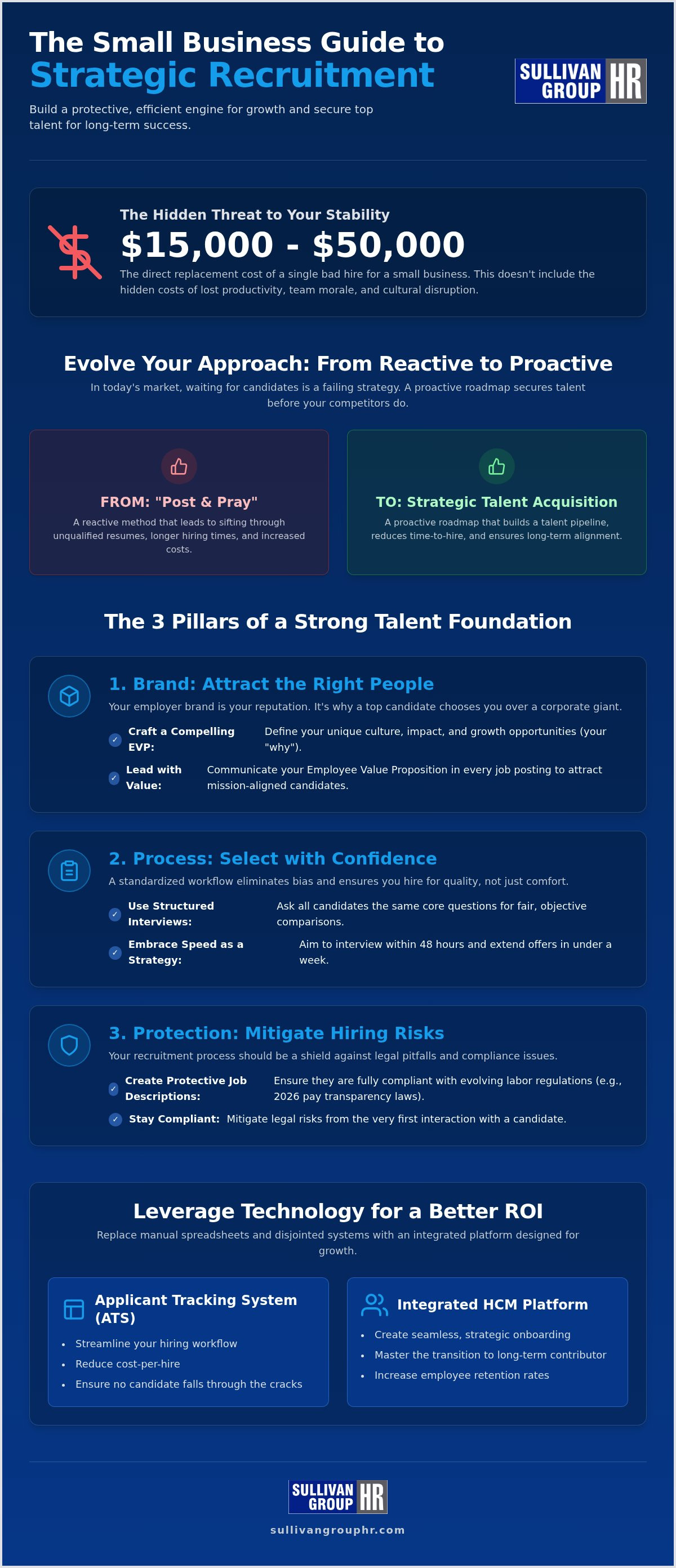
Did you know that a single bad hire can cost your small business between $15,000 and $50,000 in replacement costs? When you're trying to scale, those numbers aren't just statistics; they're direct threats to your stability. Are you tired of sifting through hundreds of unqualified resumes? Do you worry about staying compliant with the latest 2026 pay transparency laws? Implementing effective recruitment strategies for small business isn't just about filling seats. It's about building a protective, efficient engine for growth.
We understand that hiring feels like a high-stakes gamble when you're managing everything yourself. You need a process that works as hard as you do. This guide will help you master the art of attracting, hiring, and retaining top talent with a streamlined system designed for long-term success. We'll walk you through a three-part framework of brand, process, and protection to ensure your business stays safe from legal pitfalls. By the end, you'll know how to lower your cost-per-hire and secure the people who will help you build your legacy.
Key Takeaways
- Shift from reactive "post and pray" methods to a proactive roadmap that secures top talent before your competitors do.
- Discover how modern recruitment strategies for small business rely on a strong Employee Value Proposition to attract high-quality candidates.
- Streamline your hiring workflow by replacing manual spreadsheets with a professional Applicant Tracking System (ATS) to reduce your cost-per-hire.
- Mitigate legal risks by transforming your job descriptions into protective documents that ensure full compliance with evolving labor regulations.
- Master the transition from candidate to long-term contributor by leveraging an integrated HCM platform for seamless, strategic onboarding.
Why Recruitment Strategies for Small Business Must Evolve in 2026
The era of "post and pray" is officially over. In the 2026 labor market, simply listing a job on a board and waiting for resumes is a recipe for stagnation. Small teams no longer have the luxury of reactive hiring. Instead, effective recruitment strategies for small business must function as proactive roadmaps. This means identifying talent gaps before they become crises and building a pipeline of candidates who align with your long-term vision.
A structured recruitment process acts as a shield for your company. Hiring the wrong person is a mistake you can't afford to ignore. According to 2026 data from The Recruitment Alternative, a single bad hire can cost a small business between $15,000 and $50,000 in replacement costs. These figures don't even account for the hidden toll on your office culture or the dip in team productivity. It's about more than just a paycheck; it's about the stability of your entire organization.
At Sullivan Group HR, our philosophy is designed to move you away from transactional hiring. We focus on a three-part framework: Attract, Protect, and Grow. We help you find the right people, implement protective HR consulting to mitigate risks, and provide the tools to grow your workforce sustainably. This approach ensures that every new team member is an investment in your future, not just a temporary fix for a vacancy.
The Shift from Hiring to Talent Acquisition
Filling a role is a transaction. Acquiring talent is a strategy. The difference lies in your intent. Are you just looking for someone to handle tasks, or are you looking for a contributor who will drive your business forward? Small businesses actually hold a unique agility advantage here. While large corporations are often slowed down by layers of bureaucracy, you can move with speed. In 2026, the most successful small firms are those that can interview a candidate within 48 hours and extend an offer in under a week. Is your current process building a team or just filling a desk?
The ROI of a Strategic Approach
A documented strategy does more than just organize your calendar. It creates a measurable return on your investment. When you standardize your outreach and screening, you naturally reduce your time-to-hire and cost-per-hire. Clear, consistent processes also lead to higher retention rates because candidates feel supported from their very first interaction with your brand. Talent Acquisition ROI is the measurable impact of quality hires on business revenue.
Building Your Three-Part Talent Foundation: Brand, Process, and Outreach
To build a sustainable team, you need more than just a job description. You need a foundation built on three essential pillars: Brand, Process, and Outreach. Your Brand attracts. Your Process selects. Your Outreach finds. Without all three, your recruitment strategies for small business will lack the stability needed for long-term growth. Are you ready to stop reacting to vacancies and start building a talent engine?
In a competitive market, your "Employer Brand" is your most powerful tool. It's the reputation you hold in the minds of potential candidates. Why should a talented professional choose your small team over a corporate giant? Large firms have big budgets, but you have personal impact. Use that to your advantage. By highlighting your unique culture and the direct influence an employee has on your success, you position yourself as a preferred partner in their career.
Crafting a Compelling Employee Value Proposition (EVP)
Your EVP is the "why" behind your work. It highlights the culture, impact, and growth opportunities unique to your business. To stand out, you must communicate these values in every job posting. Often, strategic benefits management solutions define your EVP by showing candidates you value their health and security. It's about building a relationship, not just a payroll entry. When you lead with value, you attract candidates who align with your mission.
Standardizing the Interview Process
How do you ensure you're hiring for quality rather than just comfort? Structured interviews are the answer. By asking every candidate the same set of questions, you eliminate unconscious bias. Create a scorecard to measure candidates against your core values. This objective data makes the final decision much easier. Modern applicant tracking systems can help manage this workflow, ensuring no candidate falls through the cracks during the screening phase.
Remember, speed is a strategy. In 2026, top talent is off the market in days. If your process is too slow, you'll lose the best people to more agile competitors. Move candidates through the funnel quickly to secure the win. If you feel overwhelmed by the administrative weight of these steps, our human capital management solutions can help you automate the burden.
Finally, expand your outreach. Don't limit yourself to traditional job boards. Move toward social sourcing and employee referrals. Referral programs are particularly effective. Research shows they can cost 50-70% less than other channels and lead to 25% longer retention. Your current employees are your best advocates. Use their networks to find your next great hire.
Leveraging Technology: The ROI of an Applicant Tracking System (ATS)
Are you still managing your hiring with a mess of spreadsheets and scattered email folders? Relying on manual tracking isn't just slow; it's a direct risk to your business growth. Spreadsheets are static, prone to error, and often create "data silos" where vital candidate information disappears. An Applicant Tracking System (ATS) is the professional alternative. It serves as a central hub for every interaction, ensuring your recruitment strategies for small business are organized, compliant, and scalable.
By adopting a unified system like isolved, you link your recruitment data directly to your payroll and human capital management functions. This integration eliminates the need for double data entry and reduces the administrative burden that keeps you chained to your desk. Instead of pushing paper, you can focus on the person. The isolved platform acts as the engine behind your strategy, professionalizing your approach from the first click to the final hire. It moves your data through the lifecycle with precision, safety, and speed.
Automation That Doesn't Lose the Human Touch
Automation doesn't have to feel robotic. In fact, it often makes you more responsive to candidate needs. You can set up automated email triggers to keep applicants informed about their status, preventing the "black hole" experience that ruins employer brands. Self-service scheduling allows candidates to pick their own interview times, removing the exhausting back-and-forth of calendar tag. These tools help you build a talent pipeline of qualified professionals who might be perfect for future roles, even if they aren't the right fit today.
Data-Driven Decision Making
Which job boards are actually worth your budget? Without data, you're just guessing. An ATS tracks the metrics that matter most: source of hire, time-to-fill, and candidate experience scores. This transparency allows you to stop wasting money on underperforming channels and double down on the sources that deliver high-quality talent. Seeing how an all-in-one HR platform streamlines the entire lifecycle reveals the true ROI of modern technology. It transforms hiring from a gut-feeling gamble into a predictable, results-oriented system that protects your bottom line.
Navigating Compliance and Risk During the Hiring Lifecycle
What is the hidden cost of a "quick" hire? For many entrepreneurs, the answer is a devastating Department of Labor (DOL) audit. Unintentional non-compliance with federal labor laws is the #1 risk facing growing teams today. When you're refining your recruitment strategies for small business, you must view every job description as a legal document rather than just a marketing piece. In 2026, pay transparency laws in states like California, Colorado, New York, and Washington require you to disclose salary ranges upfront. Failing to do so isn't just a bad look; it's a legal liability that can lead to significant fines.
Modern workforce management also demands absolute precision with I-9 compliance and E-Verify. A professional HR partner acts as your shield, ensuring that every form is filed correctly and every deadline is met. We move beyond the paperwork to provide protective HR consulting that anticipates risks before they become lawsuits. By standardizing your approach, you transform your hiring process from a point of vulnerability into a pillar of organizational security. This proactive stance protects your legacy and your bottom line.
Common Legal Pitfalls in Small Business Recruiting
Are your interview questions putting you at risk? Avoiding discriminatory language is only the beginning. You must also navigate complex wage and hour regulations to ensure your recruitment strategies for small business remain compliant. As regional experts, we understand the specific nuances of your territory. Consider these critical areas:
- FLSA Classification: As of 2026, the federal salary threshold for exempt employees is $684 per week. In California, the minimum salary for exempt employees is $70,304 annually. Misclassification is a common and costly error.
- Mandatory Notices: California employers must provide a written "Know Your Rights" notice to all employees by February 1, 2026.
- Standardized Testing: You need a consistent background check and drug-testing policy to avoid claims of bias or unfair treatment during the screening phase.
The Protective Power of Documentation
If it isn't documented, it didn't happen. Every candidate interaction, from the initial screening to the final offer letter, should be stored within a secure HCM platform like isolved. Managing sensitive candidate data requires strict adherence to privacy regulations to prevent data breaches. Integrating HR risk management into your daily operations is the only way to truly protect your assets. Don't leave your company's future to chance. Contact our team for expert human resources consulting to audit your current hiring practices and secure your growth.
Scaling Your Success with Integrated Human Capital Management
Many guides end the moment the contract is signed. We believe that is where the real work begins. Successful recruitment strategies for small business are only as good as the retention that follows. If your new hire feels lost on day one, you risk losing that $15,000 to $50,000 investment we discussed earlier. An integrated human capital management approach ensures that the promises made during the interview are kept during employment. By using a platform like isolved, you create a seamless bridge that carries a candidate from the applicant tracking system directly into your culture.
The "Sullivan Advantage" lies in the combination of leading technology and expert human resources consulting. We don't just hand you a login and leave you to figure it out. We provide a total talent solution that protects your business while you scale. This approach moves you away from transactional hiring and toward a model of long-term organizational security. When your technology and your strategy are in sync, your growth becomes predictable rather than accidental.
Onboarding: The Bridge Between Recruiting and Retention
The first 90 days are the most critical period for any new team member. This is when they decide if they made the right choice. Why waste this valuable time on a "paperwork mountain"? Automation allows your new hire to complete tax forms, direct deposit setups, and handbook acknowledgments before they even step into the office. This shift ensures that day one is about mission, vision, and team connection rather than administrative drudgery. For a deeper dive into these transitions, review our applicant tracking and onboarding guide.
Partnering for Growth
Scaling a business is a heavy lift. You shouldn't have to carry the administrative burden alone. Sullivan Group HR acts as your fractional HR department, providing the stability of an established regional expert with over 25 years of history. We combine the industry-leading isolved platform with high-touch consulting to protect your growth. This partnership offers the peace of mind that comes from knowing your payroll administration and employee benefits management are handled with professional rigor.
When your recruitment strategies for small business are backed by a robust HCM system, you aren't just filling roles. You are building a foundation that can withstand the pressures of a competitive market. Don't just hire. Build a system that allows your team to thrive. Focus on your business potential; we’ll focus on the people who get you there.
Securing Your Future with a Total Talent System
Is your business ready to move from simply filling roles to building a legacy? Mastering recruitment strategies for small business requires a shift from reactive hiring to a proactive system of brand, process, and protection. By standardizing your outreach and leveraging the power of an integrated Applicant Tracking System, you remove the guesswork from growth. You stop being a resume reader and start being a talent architect.
Success in 2026 isn't just about who you hire; it's about how you protect and grow them. Sullivan Group HR provides the expert HR consulting and comprehensive payroll services you need to navigate complex regulations with confidence. With access to the leading isolved HCM platform, you can automate the administrative burden and focus on your true potential. We've been helping businesses scale since 1998, and we're ready to act as your reliable advocate.
Ready to transform your hiring process? Explore Sullivan Group HR's integrated solutions today.
Your professional potential is limitless when you have the right people in your corner. Let's build something lasting together.
Frequently Asked Questions
What are the most effective recruitment channels for small businesses in 2026?
Employee referral programs remain the gold standard because they cost 50% to 70% less than other sourcing channels. In 2026, social sourcing on professional networks and niche industry boards also outperforms generic methods. Small teams should leverage their agility to reach candidates where they already spend time. These recruitment strategies for small business succeed when you turn your current staff into your most vocal brand advocates through structured bonus programs.
How much should a small business spend on recruitment strategies?
While costs vary, research shows entry-level Applicant Tracking Systems often range from $25 to $100 per month. You should also budget for referral bonuses, which typically fall between $500 and $2,000 per successful hire after a 90-day period. The goal is to lower your overall cost-per-hire by investing in systems that prevent bad hires. Remember that a single hiring mistake can cost your business up to $50,000 in replacement expenses.
Is an Applicant Tracking System (ATS) worth it for a company with fewer than 50 employees?
Absolutely. Even for small teams, an Applicant Tracking System is vital for maintaining a professional image and legal compliance. About 94% of recruiters report that an ATS significantly improves their hiring process. Using a unified platform like isolved removes the risk of "data silos" and disorganized spreadsheets. It automates the administrative burden so you can focus on the human connection during interviews. Technology is the engine that professionalizes your growth.
How can I make my small business stand out to top-tier candidates?
Your agility is your greatest asset. While corporations move slowly, you can interview and extend offers within days. Focus on your Employee Value Proposition by highlighting the direct impact a new hire will have on your company's success. Offering competitive employee benefits management and a clear path for growth makes you a preferred employer. Candidates in 2026 value flexibility, transparency, and the feeling that their work actually matters to your mission.
What are the legal requirements for hiring new employees in the US?
You must comply with federal and state regulations, including I-9 verification, E-Verify, and FLSA classifications. In 2026, pay transparency is a major requirement in several states, requiring salary ranges on all job postings. You also need to provide mandatory "Know Your Rights" notices and maintain OSHA Form 300A for workplace safety. Partnering with an expert for human resources consulting ensures you stay protected from costly Department of Labor audits and legal pitfalls.
How do I write a job description that attracts the right talent?
Treat your job description as both a marketing tool and a legal document. Start with a compelling summary of your culture and the specific impact of the role. Include clear, transparent salary ranges to comply with modern labor laws and attract high-quality applicants. List essential functions and required skills to align with your internal interview scorecards. This clarity helps you filter out unqualified candidates early, saving you hours of wasted screening time.
Can HR outsourcing help with small business recruitment?
Yes, HR outsourcing provides you with a fractional HR department that scales alongside your business. You gain access to industry-leading technology like the isolved HCM platform without the overhead of a full internal team. This partnership covers everything from payroll administration to workers' compensation insurance. It gives you the peace of mind that your recruitment strategies for small business are backed by professional rigor and over 25 years of hard-earned regional expertise.
What is the difference between recruitment and talent acquisition?
Recruitment is a transactional response to a vacancy, while talent acquisition is a proactive roadmap for growth. Recruitment focuses on filling a desk today; talent acquisition focuses on building a pipeline for tomorrow. One is reactive, and the other is strategic. By shifting your mindset toward talent acquisition, you ensure that every new hire is a long-term investment in your company's stability rather than just a temporary fix for a busy schedule.


