

What if your workers' compensation premium wasn't a bill you simply had to accept, but a controlled variable you could actually influence? Most business owners view insurance as a fixed cost or, worse, an administrative nightmare filled with complex audits and the constant fear of OSHA fines. It's frustrating to watch your E-Mod rate climb because of factors that feel out of your control. We understand that burden. Effective workers compensation risk management shouldn't feel like a defensive battle against regulations. Instead, it's about taking proactive steps to protect your people and your bottom line simultaneously.
You deserve a partner who acts as a coach, helping you turn these challenges into a competitive edge. This 2026 guide shows you exactly how to lower annual premiums, create a safer workplace, and build a streamlined return-to-work process. We'll explore how integrated HR technology, like the isolved platform, simplifies claims and ensures you meet the March 2, 2026, OSHA electronic reporting deadline. By the end of this article, you'll have a clear roadmap to transform your insurance strategy into a pillar of long-term organizational security.
Key Takeaways
- Shift your perspective from viewing insurance as a fixed cost to seeing it as a growth engine by uncovering the hidden productivity costs of workplace injuries.
- Build a top-down safety culture through a four-pillar framework focused on prevention, consistent training, thorough documentation, and active claims management.
- Discover how integrating your insurance with a unified payroll system simplifies workers compensation risk management and prevents premium overpayment through real-time data.
- Implement a Return-to-Work program to safely bring employees back to transitional duty, effectively lowering disability payments and reducing lost-time claim status.
- Learn how a proactive partnership can help you navigate the 2026 regulatory landscape while focusing on your core mission to protect, support, and grow your business.
Beyond the Premium: Why Workers Compensation Risk Management is Your Growth Engine
Effective workers compensation risk management is more than just a defensive posture. It is a proactive strategy designed to identify, evaluate, and mitigate workplace hazards before they ever turn into a claim. While most business owners understand What is Workers' Compensation? as a basic legal requirement, fewer recognize it as a tool for financial health. Is your current policy protecting your people, or just checking a compliance box? A policy is a safety net, but risk management is the floor your business stands on. When you control the environment, you control the costs.
The Financial Anatomy of an Injury
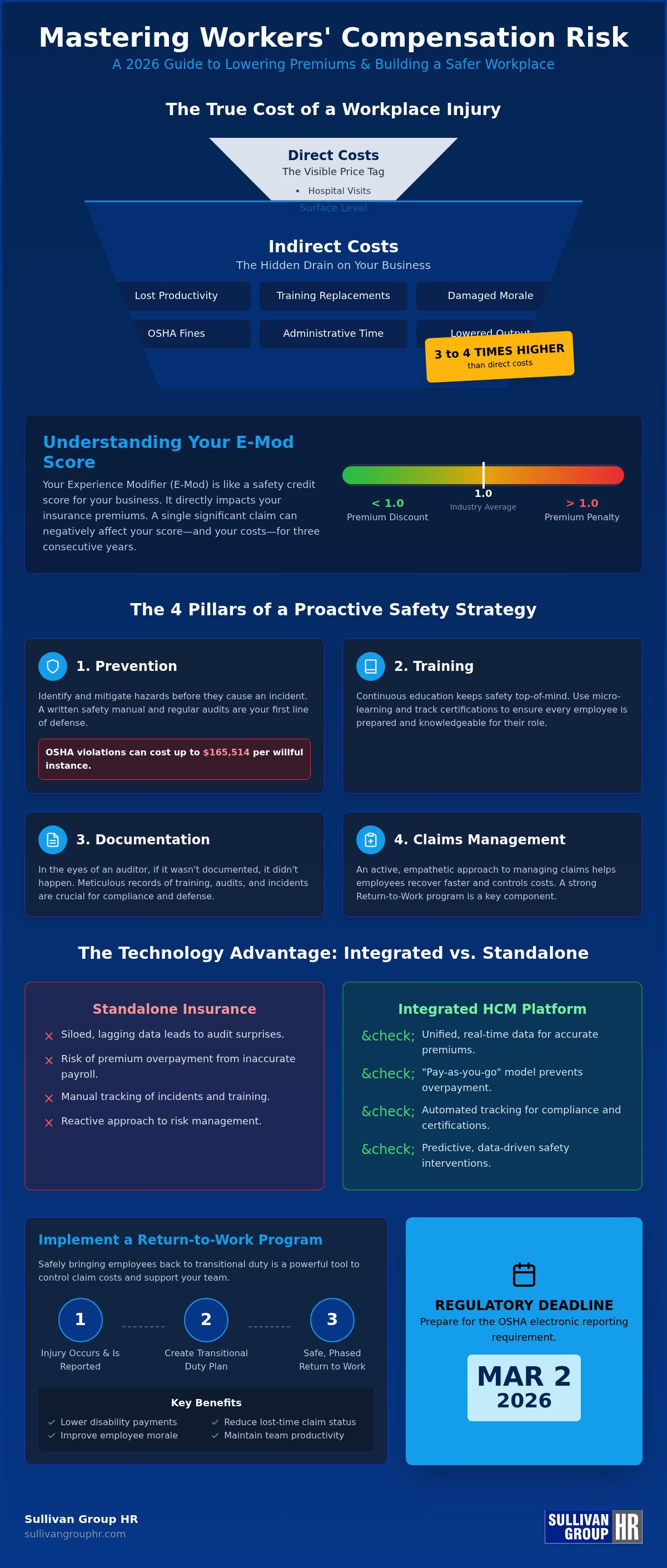
Every workplace accident has a price tag that goes far beyond the initial medical bill. Direct costs like hospital visits and legal fees are just the tip of the iceberg. Beneath the surface lie indirect costs: lost productivity, the expense of training replacements, and the subtle but real damage to team morale. These hidden drains on your capital can be three to four times higher than the direct insurance claim.
Your Experience Modifier, or E-Mod, is the mechanic that drives these costs home. Think of it as your business's safety credit score. If your E-Mod is above 1.0, you are paying a penalty premium. If it is below 1.0, you receive a discount. Because this number is calculated based on a three-year rolling average, a single significant claim can spike your premiums for three consecutive years. A high E-Mod doesn't just cost money; it damages your competitive standing. In many industries, a high rating can even disqualify you from bidding on lucrative contracts.
Predictive vs. Reactive Risk Management
Waiting for an accident to happen is the most expensive way to manage a business. Reactive companies spend their time filing reports, managing audits, and paying fines. In 2026, the industry has shifted toward data-driven safety interventions. Predictive management uses integrated technology to spot trends and address small issues before they result in serious injuries.
This approach does three things for your organization: it lowers costs, ensures compliance, and strengthens your brand. By focusing on workers compensation risk management, you build a protective brand identity that makes talent acquisition easier. Potential employees want to work where they feel valued and safe. When you prioritize their well-being, you prove that your commitment to your team is a strategic investment in your company's future growth.
The 4 Pillars of a Proactive Safety and Compliance Strategy
A truly resilient business doesn't just buy insurance; it builds a shield. Successful workers compensation risk management rests on four essential pillars: Prevention, Training, Documentation, and Claims Management. If safety is only a poster in your breakroom, it isn't a strategy. It's a liability. Real protection starts at the top. When leadership treats safety as a core value, employees follow suit. This cultural commitment is the difference between a thriving workplace and one plagued by avoidable accidents.
Prevention requires more than good intentions. You need a clear, written safety manual tailored to your specific industry risks. A generic template won't stop a specialized injury. Regular, documented safety audits are equally vital. These aren't just for your own peace of mind. They are your primary defense against OSHA citations. As of January 15, 2026, willful violations can carry penalties as high as $165,514 per instance. If you can prove you actively look for and fix hazards, you protect your bank account and your people.
Continuous Safety Training and Education
Training shouldn't be a once-a-year event that everyone sleeps through. Modern safety education thrives on 'micro-learning' and brief safety moments before shifts. These short, punchy sessions keep hazards top-of-mind without disrupting workflow. For high-risk roles, specialized certifications are non-negotiable. We help clients use isolved HCM to track training completion and certifications automatically. This ensures no one steps onto a job site without the proper knowledge to stay safe.
Meticulous Documentation and Reporting
In the eyes of an auditor or a court, if it isn't documented, it didn't happen. This is the golden rule of risk management. You must streamline your first report of injury (FROI) to reduce claim lag time. Faster reporting leads to better outcomes for everyone. You also need digital accuracy for your OSHA logs. Remember that the deadline to electronically submit your 2025 injury data is March 2, 2026. Between February 1 and April 30, 2026, you must also post your OSHA Form 300A summary in a visible location.
Effective claims management often includes a structured Return-to-Work Program. This keeps your costs in check by bringing injured employees back to transitional duty as soon as it's safe. If you're feeling overwhelmed by these moving parts, our HR consulting team can help you build a custom compliance roadmap.
Integrated HCM vs. Standalone Insurance: A Risk Management Comparison
Why do many businesses still manage payroll in one folder and insurance in another? This siloed approach is a recipe for administrative friction. Traditional insurance management is often a game of catch-up. You pay an estimated premium upfront, manage payroll separately, and hope the end-of-year audit doesn't break the bank. This model creates blind spots that lead to overpayments and missed risks. An integrated approach connects your unified payroll system directly to your coverage. It transforms workers compensation risk management from a manual chore into an automated, data-driven function.
A common objection is that integrated systems feel like "more work" to set up. In reality, they eliminate the tedious double-entry that causes most clerical errors. When your HR technology and insurance work together, data flows naturally between them. This reduces the time spent on paperwork and ensures your records are always audit-ready. It's about working smarter; it's about accuracy; it's about reclaiming your time.
The Power of Unified Data
When your time and attendance data lives in the same platform as your insurance, you gain instant visibility. Did an injury occur during an authorized shift? Unified data provides the proof you need to verify claim accuracy. This level of detail is essential for Proactive Safety and Compliance. By having all payroll and insurance data in one platform, you can identify "risk hotspots" in specific departments before they become systemic issues. Plus, when audit season arrives, you aren't digging through filing cabinets or spreadsheets. All the necessary documentation is already organized and accessible.
Pay-As-You-Go: Cash Flow Protection
Cash flow is the lifeblood of any growing business. Traditional policies often require large upfront down payments based on payroll estimates. Pay-As-You-Go workers' comp changes that by calculating your premium based on real-time payroll data every cycle. If your staff count fluctuates, your premium adjusts immediately. This eliminates the "audit surprise" at the end of the policy year where you might owe thousands in back premiums. Sullivan Group HR facilitates this seamless connection, ensuring your coverage perfectly mirrors your current workforce. It protects your capital, simplifies your billing, and provides a level of financial stability that standalone policies simply cannot match.
Turning Theory into Action: Implementing a Return-to-Work Program
What happens after an accident occurs? Many business owners think the story ends once the claim is filed. It doesn't. A Return-to-Work (RTW) program is a deliberate strategy to bring injured employees back to transitional duty safely. It's about keeping your team whole while protecting your bottom line. When you proactively manage the recovery process, you move from being a bystander to being a coach for your employee's return.
The financial benefits of a structured RTW program are substantial. By offering light-duty tasks, you significantly lower disability payments and reduce the "lost time" status of a claim. This is a critical component of workers compensation risk management. A claim with no lost time has a much smaller impact on your E-Mod rate than one where the employee stays home for weeks. Beyond the numbers, keep the human element in mind. Psychological studies show that staying connected to the workplace speeds up physical recovery. When people feel valued and productive, they heal faster.
To make this work, you need precision. You can't simply tell an employee to "take it easy." You need clear, written job descriptions that outline the physical requirements for every light-duty role. This clarity protects the employee from re-injury and protects the company from liability. It ensures everyone understands what "transitional" actually means.
The 5 Steps to an Effective RTW Program
- Step 1: Formalize the policy before an injury occurs. Having a plan in place prevents panic and ensures consistency.
- Step 2: Collaborate with medical providers. Share those light-duty job descriptions with the doctor to understand specific functional limitations.
- Step 3: Identify transitional tasks. Find duties that provide real value to the company, such as inventory checks, safety audits, or administrative support.
- Step 4: Maintain consistent communication. Don't let an injured employee feel forgotten; regular check-ins boost morale and engagement.
- Step 5: Monitor progress. Recovery isn't static. Adjust duties as the employee regains strength and mobility.
Managing the Legal Nuances of RTW
Implementing these programs requires a careful balance of empathy and compliance. You must ensure your RTW efforts align with the Americans with Disabilities Act (ADA) and the Family and Medical Leave Act (FMLA). Handling a "refusal of light duty" situation requires a professional, documented approach to avoid legal pitfalls. We often suggest using HR risk management consulting to navigate these complex legal overlaps. If you want to build a program that protects your business and supports your staff, schedule a consultation with our experts today.
Navigating the 2026 Risk Landscape with Sullivan Group HR
How do you stay focused on your professional mission when administrative burdens keep pulling you away? Leading a business in 2026 requires a delicate balance of technological precision and human empathy. It's not enough to simply have a policy in place. You need a partner who acts as a protective shield for your organization. At Sullivan Group HR, we bridge the gap between high-powered technology and the human touch. We understand that behind every data point in your workers compensation risk management strategy is a real person. Our mission is to ensure those people stay safe while your business stays profitable.
We operate within a simple, functional framework: Protect, Support, Grow. We protect your assets through rigorous compliance and safety oversight. We support your leadership through dedicated HR consulting and advocacy. Finally, we help you grow by removing the administrative roadblocks that stifle your momentum. You don't have to navigate this complex landscape alone. You deserve a coach and ally who understands the nuances of your industry and treats your success as the primary metric of our own.
The Sullivan Difference: Beyond the Platform
Data is a powerful tool, but it doesn't have a heartbeat. The isolved platform provides the industry's best numbers, but human expertise is required to interpret what those numbers mean for your specific future. A tech-only vendor might flag a trend, but a dedicated HR partner helps you fix the root cause of a safety issue. We prioritize interpersonal value over automated, tech-only processes because we know that safety is personal. Our commitment is to provide a "no-nonsense" authority that values your people over a sterile, bureaucratic system. We are here to interpret the data, refine your strategy, and advocate for your best interests.
Next Steps: Securing Your Business for 2026
The best time to strengthen your defenses was before an accident happened. The second best time is today. Your journey toward a more resilient organization begins with a comprehensive risk management audit. Our team will review your current safety manuals, E-Mod history, and documentation processes to find gaps before they become expensive claims.
Transitioning to an integrated payroll and workers' comp model is the most effective way to secure your cash flow and simplify your audits. It's time to trade your administrative nightmares for true peace of mind. You can build a safer workplace and a more profitable company at the same time. Protect your business and your people with Sullivan Group HR.
Secure Your Future with Strategic Protection
Is your business ready to move beyond the administrative burden of insurance audits and premium spikes? Transforming your workers compensation risk management from a line-item expense into a growth engine is entirely within your reach. By integrating the industry-leading isolved HCM platform and adopting a proactive safety culture, you protect your most valuable asset: your people. We've seen how clear Return-to-Work programs and pay-as-you-go options stabilize cash flow while lowering long-term costs.
Since 1998, we have acted as a coach and ally for business owners who want to focus on their mission rather than their paperwork. You don't have to navigate the 2026 regulatory landscape alone. Our expert HR consulting provides the hard-earned wisdom you need to build a resilient, safer, and more profitable workplace. It's time to trade uncertainty for peace of mind. Protect your business and your bottom line with Sullivan Group HR. We are ready to help you grow with confidence.
Frequently Asked Questions
What is the difference between workers' compensation insurance and risk management?
Insurance is the financial contract that pays for claims, while workers compensation risk management is the proactive strategy used to prevent those claims from occurring. One is a reactive safety net; the other is a protective shield. By identifying hazards, implementing safety protocols, and training staff, you reduce the likelihood of injury. This comprehensive approach ensures you aren't just paying for accidents but actively working to eliminate them from your daily operations.
How much can a proactive risk management program actually lower my premiums?
A proactive program lowers premiums by improving your Experience Modifier (E-Mod) over a three-year rolling period. While we don't invent specific discount percentages, a lower E-Mod directly reduces the multiplier applied to your base insurance rates. By preventing lost-time accidents and managing claims efficiently, you move your business from a penalty status to a credit status. This shift can save your organization thousands of dollars in annual overhead while creating a safer environment for your team.
Is a return-to-work program mandatory for small businesses in 2026?
While federal law doesn't strictly mandate a return-to-work program for every small business, many state regulations and the Americans with Disabilities Act (ADA) make it a practical necessity. Implementing a program is a strategic choice that protects your bottom line. It reduces the duration of disability payments and helps you maintain your workforce. Most successful companies in 2026 view these programs as essential tools for managing recovery and minimizing claim costs.
What happens if my business fails a workers' compensation audit?
Failing an audit usually results in a premium adjustment, which means you'll receive a bill for the difference between your estimated and actual payroll. You might also face interest charges or penalties if the discrepancy is significant. Beyond the immediate financial hit, a poor audit can trigger more frequent reviews from your carrier. Using an integrated system helps ensure your data is accurate, so you can avoid these expensive and stressful surprises.
Can integrated HR software like isolved really reduce workplace accidents?
Integrated software like isolved reduces accidents by providing a centralized location to track safety training and certifications. It ensures that no employee is assigned to a high-risk task without the proper education. By analyzing incident reports in real time, you can identify specific departments or shifts where hazards are more frequent. This data-driven approach allows you to intervene with targeted safety measures before a minor issue becomes a major catastrophe.
What are the most common OSHA compliance mistakes for mid-sized companies?
Common mistakes include:
- Failing to submit injury data electronically by the March 2, 2026, deadline.
- Neglecting to post the OSHA Form 300A summary in a visible location.
- Using a generic safety manual that doesn't address specific industry hazards.
Neglecting these steps can lead to willful violation penalties that can exceed $165,514 as of 2026. Maintaining digital accuracy and following a strict reporting schedule are the best ways to protect your business from these avoidable expenses.
How does 'pay-as-you-go' workers' comp differ from traditional policies?
Traditional policies require a large upfront deposit based on estimated payroll, which often leads to a large bill or refund after an audit. Pay-as-you-go workers' comp calculates your premium based on your actual payroll each cycle. This model improves your cash flow because you only pay for the coverage you are currently using. It eliminates the need for large down payments and significantly reduces the risk of an unexpected audit penalty at year-end.
What should I do immediately after an employee reports a workplace injury?
Your first priority is ensuring the employee receives appropriate medical attention immediately. Once they are safe, you must document the incident and file a First Report of Injury with your insurance carrier to minimize claim lag time. Start an internal investigation to understand the root cause of the accident and identify any immediate hazards that need fixing. Consistent communication with the injured worker is also vital to support their recovery and return.


