

What if the greatest risk to your business isn't a market shift, but a document you didn't know you needed? It's a question that keeps many entrepreneurs awake at night, especially as federal regulations and state laws grow more complex by the day. You likely feel the weight of tracking every Form I-9 update or worrying about the latest ACA affordability thresholds. We understand that managing a growing team is a massive responsibility. The fear of a surprise audit can be paralyzing. That's why having a reliable HR compliance audit checklist is no longer just a best practice; it's your primary line of defense.
You deserve a partner who helps you move from reactive stress to proactive security. In this article, we'll provide a clear, actionable framework designed to identify risks and secure your organizational future. We'll cover critical 2026 updates, including new overtime tax reporting requirements, updated benefit limits, and shifting state regulations. You'll learn how to use your HCM platform as a single source of truth to simplify data management and gain true peace of mind. Let's transform your compliance process into a streamlined system that protects your people and your legacy.
Key Takeaways
- Discover why a proactive self-audit is your best defense against the rising costs of federal penalties and regulatory shifts in 2026.
- Master a three-part HR compliance audit checklist that organizes your requirements into recruitment, retention, and reporting for maximum clarity.
- Learn to spot high-stakes red flags, like independent contractor misclassifications, that often trigger costly Department of Labor investigations.
- Implement a structured 5-step action plan to build an internal audit team and define a clear, manageable scope for your organizational review.
- See how integrating the isolved HCM platform with expert human consulting creates a single source of truth for all your essential employee data.
The Stakes of HR Compliance in 2026: Why a Self-Audit is Non-Negotiable
Are you truly protected, or have you just been lucky so far? For many business owners, the line between a successful year and a legal nightmare is thinner than they realize. As we move through 2026, federal oversight has sharpened its focus on workplace transparency and reporting. Relying on "how we've always done it" isn't a strategy; it's a gamble. A comprehensive HR compliance audit checklist helps you stop guessing and start knowing. It's the difference between being blindsided by a penalty and standing on firm ground.
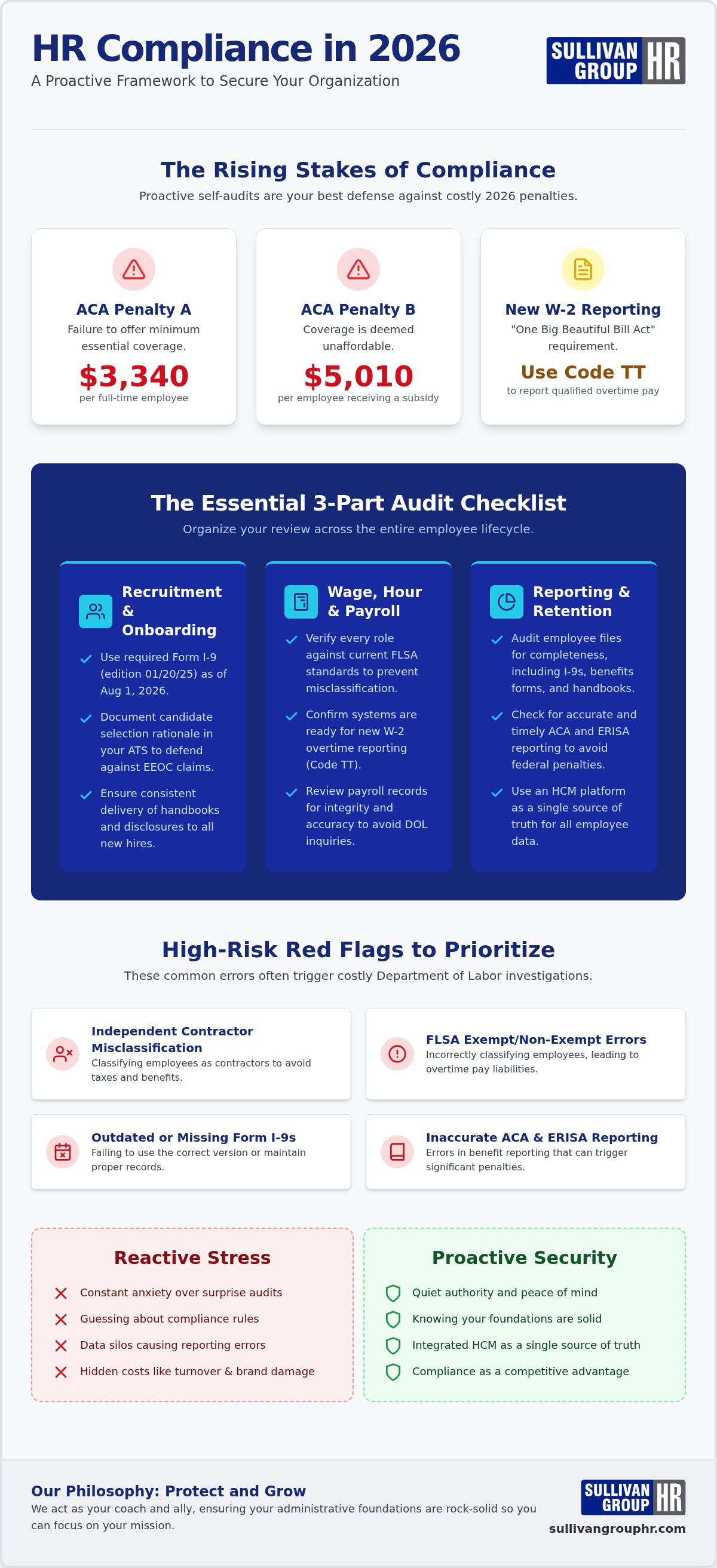
The financial impact of oversight is rising. Consider the Affordable Care Act (ACA) penalties for 2026. Failing to offer minimum essential coverage (Penalty A) now costs $3,340 per full-time employee. If your coverage is deemed unaffordable, Penalty B jumps to $5,010 per employee who receives a subsidy. These aren't just administrative fees. They are bottom-line threats that can derail your growth. When you add the escalating costs of Fair Labor Standards Act (FLSA) violations and ERISA reporting errors, the argument for a self-audit becomes undeniable.
This year also introduces specific challenges like the "One Big Beautiful Bill Act." This law requires employers to separately track and report qualified overtime premium pay on Form W-2 using the new Code TT. If your systems aren't prepared for this level of granularity, you're inviting an audit. Beyond the fines, reactive compliance triggers hidden costs like employee turnover and brand damage. Top talent wants to work for organizations that value accuracy, fairness, and professional rigor.
The Evolving Federal Landscape
The DOL, EEOC, and IRS have synchronized their efforts to regulate the 2026 workplace. Many leaders fall for the "set it and forget it" myth, believing their payroll software handles everything automatically. Software is a tool, not a strategist. True protection comes from integrated human capital management. This approach serves as your first line of defense by connecting your data silos. It ensures that your recruitment, pay, and benefits records all tell the same compliant story to federal agencies.
Moving from Anxiety to Authority
Compliance doesn't have to feel like a burden. When you approach it proactively, it becomes a competitive advantage. An organization that masters its HR compliance audit checklist signals stability to investors and creates a culture of trust for its workforce. You move from a state of constant anxiety to one of quiet authority. At Sullivan Group HR, we call this our "Protect and Grow" philosophy. We act as your coach and ally, ensuring your administrative foundations are rock-solid so you can focus on your actual mission.
The Essential HR Compliance Audit Checklist
A comprehensive HR audit in 2026 is an end to end examination of the employee lifecycle designed to ensure legal adherence and operational integrity. You shouldn't view this as a simple box-ticking exercise. Instead, it's a strategic review that protects your business from the inside out. To make this manageable, we organize the requirements into a three-part framework: Document, Verify, and Remediate. By first gathering your records, then checking them against 2026 standards, and finally fixing the gaps, you build a culture of permanent readiness. Utilizing payroll administration outsourcing can often eliminate the manual data entry errors that trigger federal inquiries in the first place.
Recruitment and Onboarding Compliance
Your compliance journey begins before a hire even starts. As of August 1, 2026, all employers must use the Form I-9 with the edition date of 01/20/25. This isn't optional. Every employee must be authorized to work without exception. Beyond I-9s, your applicant tracking system must document exactly why candidates were or weren't selected. This documentation is your primary defense against EEOC claims. A consistent onboarding lifecycle ensures that every new team member receives the same handbooks and disclosures, creating a fair and documented start for everyone.
Wage, Hour, and Payroll Integrity
The Department of Labor (DOL) is increasingly focused on how businesses classify their teams. Misclassifying an exempt employee as non-exempt can lead to years of back-pay liabilities. This HR compliance audit checklist requires you to verify every role against current FLSA standards. For 2026, you must also comply with the "One Big Beautiful Bill Act," which requires separate reporting of overtime premium pay on Form W-2 using Code TT. If you're still using manual spreadsheets to track these hours, you're inviting an audit. Automated systems ensure accuracy across multi-state jurisdictions where tax laws vary wildly.
Benefits and Risk Management
Managing strategic benefits management solutions requires precise record-keeping to satisfy ERISA and ACA mandates. For 2026, your health plans must remain "affordable," meaning the employee's contribution cannot exceed 9.96% of their household income. You must also ensure that your workers' compensation coverage matches the actual job functions of your staff to prevent premium leakage or claim denials. Precision in documenting FMLA requests and approvals is equally critical. If these complexities feel overwhelming, a quick consultation with the experts at Sullivan Group HR can help you identify exactly where your documentation needs strengthening.
Identifying High-Risk Red Flags in Your HR Processes
"We're too small for the DOL to care." Have you heard this before? It's a dangerous myth that has led many small business owners into financial ruin. In reality, smaller organizations are often prime targets for investigators because they frequently lack the robust legal departments found in larger firms. A single anonymous tip or a random spot check can trigger a full scale investigation. Using a thorough HR compliance audit checklist allows you to spot these red flags before an investigator does, shifting your position from vulnerable to protected.
One of the most significant risks in 2026 involves "ghost employees" and payroll fraud. When your organization relies on fragmented systems, it's easy for administrative gaps to appear. Poorly managed workforce management solutions can allow terminated employees to remain on the payroll or permit unauthorized hours to be logged. This isn't just an internal theft issue; it's a compliance failure that distorts your tax reporting and benefits administration.
Is your employee handbook a relic of 2020? If you haven't updated your policies in the last year, you're likely carrying significant liability. A modern handbook must address 2026 realities, such as the ethical use of AI in daily tasks, expanded pay transparency requirements, and the tax implications of remote work across state lines. If your policies don't reflect current laws, they won't protect you in court.
The Misclassification Trap
The "Economic Reality" test remains the gold standard for classifying workers in 2026. Agencies look beyond your contract labels to see who actually controls the work, the tools, and the schedule. A common trap is the "salary-only" assumption. Just because you pay someone a flat weekly rate doesn't mean they are exempt from overtime. You must still satisfy the specific "duties test" for their role. If your audit reveals a misclassified worker, you should reclassify them immediately and document the correction to show a good-faith effort toward compliance.
Recordkeeping and Data Security
Proper recordkeeping is about more than just filing papers; it's about legal separation. HIPAA requirements dictate that employee medical records, including vaccination logs or disability requests, must be kept in a separate, secure file away from general personnel folders. Many businesses overlook this, creating a major red flag during audits. In 2026, electronic signatures are the legal standard, but they must be backed by a secure audit trail. Utilizing the isolved People Cloud allows you to centralize this data, ensuring that every document is encrypted, accessible, and ready for an inspector's review at a moment's notice.
How to Conduct a Self-Audit: A 5-Step Action Plan
How do you turn a daunting list of regulations into a manageable plan? You follow a proven methodology. Having a structured HR compliance audit checklist is only the first step; knowing how to execute it is what truly secures your future. This five-step action plan moves you from administrative confusion to operational clarity.
- Step 1: Assemble your audit team. Don't try to carry this burden alone. Combine your internal leadership's institutional knowledge with specialized human resources management services to ensure you have an objective, expert "second set of eyes."
- Step 2: Define your scope. Be realistic about your resources. Decide if you'll audit the entire organization at once or focus on high-risk departments, such as those with high turnover or complex commission structures, first.
- Step 3: Collect and cross-reference data. Use your HCM reporting tools to find discrepancies between payroll, benefits enrollment, and time tracking. This is where your system's integrity is truly tested.
- Step 4: Identify gaps and prioritize remediation. Not every error carries the same weight. Focus on high-stakes legal risks, like misclassified workers or expired I-9s, before moving to general policy cleanup.
- Step 5: Create a "Culture of Compliance." An audit shouldn't be a frantic one-time event. Use your findings to implement ongoing monitoring and regular staff training to prevent the same errors from resurfacing.
Data Collection and Reporting
Your audit is only as good as your data. Leveraging isolved analytics allows you to pull multi-year payroll and benefits data in seconds, providing a clear window into your historical compliance. While software handles the heavy lifting, you must still perform manual spot-checks on I-9s and personnel files to ensure signatures aren't missing and documents haven't expired. Random sampling allows you to verify the accuracy of a large dataset by closely examining a statistically significant portion, saving time while still revealing systemic issues that require your attention.
Remediating and Future-Proofing
Identifying a gap is only half the battle; you must have a clear plan to fix it. Every finding in your audit needs an assigned owner and a hard deadline for correction. This accountability prevents "compliance drift" where known issues are ignored until they become lawsuits. Setting an annual audit cadence is now the minimum standard for protecting a modern business. Viewing HR risk management as a continuous process rather than a periodic chore ensures your business remains resilient regardless of how federal laws shift. If you want an expert coach to help you build this roadmap, contact Sullivan Group HR today to secure your organizational future.
Beyond the Checklist: Partnering for Long-Term Compliance
Can a software subscription truly replace years of regulatory wisdom? While an HR compliance audit checklist provides the essential "what," an expert partner provides the "how" and the "why." Technology is a powerful tool, but it lacks the nuance to navigate the gray areas of employment law. You need more than just a digital file cabinet. You need a protective strategy that evolves alongside your business.
The Power of Integrated HCM
The isolved People Cloud turns compliance from a frantic chore into a natural byproduct of your daily operations. By utilizing a unified platform, you eliminate the manual data entry that often leads to "Human Error" risk factors. When your payroll, time tracking, and benefits data live in separate silos, discrepancies are inevitable. An integrated system ensures that an update in one area reflects across your entire organization instantly. You gain access to real-time compliance alerts that keep you ahead of the curve, such as reminders for the 2026 Form 5500 filing deadlines or changes to state minimum wage rates. Whether it's generating unified reports for ACA affordability or preparing uncertain EEO-1 filings, a single source of truth provides the data integrity you need for a stress-free audit.
Expert Consulting as Your Safety Net
Every industry faces unique pressures, and a one size fits all approach to compliance is a recipe for oversight. Your HR compliance audit checklist is your map, but an expert guide ensures you don't miss the hidden pitfalls. Human resources consulting acts as your safety net, customizing your strategy to your specific size and operational goals. At Sullivan Group HR, we take a "no-nonsense" approach to your administrative burdens. We don't hide behind dense jargon or automated ticket systems. Instead, we act as your coach and ally, providing direct answers to complex questions about worker classification or leave administration. Engaging with a fractional HR partner allows you to lead your next audit with confidence, knowing you have a team of regional experts standing behind you. You've worked hard to build your legacy. Don't let a missing document put it at risk. Partner with Sullivan Group HR today to secure your business and focus on what you do best.
Securing Your Organizational Future
Are you ready to move from administrative anxiety to quiet authority? Protecting your business in 2026 requires more than just good intentions; it demands a rigorous, proactive approach to your regulatory obligations. By mastering your HR compliance audit checklist, you've already taken the first step toward identifying high-risk red flags and streamlining your essential data. You now have a clear roadmap to verify your classifications, secure your medical files, and future-proof your payroll reporting.
True peace of mind comes from combining the industry-leading isolved HCM platform with the "no-nonsense" wisdom of expert human resources consulting. You don't have to navigate these complexities alone. Whether you need comprehensive payroll administration or robust risk management, we are here to act as your coach and ally. Your success is our primary metric. Protect your business with a professional HR audit from Sullivan Group HR and regain the freedom to focus on your mission. It's time to build a legacy that is as compliant as it is successful.
Frequently Asked Questions
What are the most common HR compliance audit findings for small businesses?
Worker misclassification is the most frequent finding, specifically regarding exempt versus non-exempt status. Many small businesses also struggle with missing signatures on Form I-9 or using outdated versions of the form. Another common error is failing to separate employee medical files from general personnel folders. These issues often stem from a lack of a structured HR compliance audit checklist to guide administrative reviews.
How often should a company conduct a full HR compliance audit?
You should conduct a full audit at least once per year to ensure your policies align with shifting federal regulations. High-growth organizations or those with remote teams in multiple states often benefit from semi-annual reviews. Regular audits help you catch small discrepancies before they turn into major liabilities. Maintaining this cadence ensures your documentation is always ready for a surprise inspection from the Department of Labor.
Can HR software like isolved handle all my compliance needs automatically?
While isolved is the industry-leading HCM platform, it works best as a tool for your overall strategy. It automates data collection, provides real-time alerts, and centralizes your records, but it can't replace human judgment. You still need expert human resources consulting to interpret specific legal nuances and customize your policies. Software provides the data integrity you need, while consulting provides the "no-nonsense" authority to lead your team.
What is the penalty for failing an I-9 or FLSA audit in 2026?
Penalties are significant and continue to rise. In 2026, the ACA penalty for failing to offer minimum essential coverage is $3,340 per full-time employee. I-9 paperwork errors can result in fines reaching thousands of dollars per form, depending on the severity of the violations. FLSA failures often lead to back-pay requirements and liquidated damages. These costs prove that proactive auditing is far more affordable than a legal defense.
Is an internal HR audit as effective as an external one?
Internal audits are great for routine maintenance, but external audits provide the objectivity needed for high-stakes compliance. An external partner brings a fresh perspective that internal teams may lack due to institutional bias or daily workloads. Professional consultants identify high-risk red flags that your staff might overlook. Combining your internal knowledge with an external expert's "coach" approach creates the most secure environment for your business.
What documents are required for a Department of Labor (DOL) audit?
A DOL audit typically requires three years of payroll records, proof of workers' compensation coverage, and your current employee handbook. You must also provide Form I-9s for all active staff and documentation for any FMLA requests or approvals. Having these records organized within a unified platform makes the process much smoother. Preparation is the difference between a quick review and a disruptive, long-term investigation.
How does HR outsourcing help with multi-state compliance?
Outsourcing simplifies the burden of tracking varying state laws for remote or distributed teams. Each state has different rules for minimum wage, sick leave, and tax filings. For example, California's 2026 minimum wage is $16.90 per hour, while Florida's increases to $15.00 in September. A professional partner ensures your HR compliance audit checklist accounts for every local requirement, protecting you from jurisdictional errors that automated systems might miss.
What should I do if I find a major compliance error during a self-audit?
Don't panic, but do act immediately. Document the error and create a clear remediation plan to fix the issue as soon as possible. Voluntarily correcting a mistake shows a good-faith effort, which can significantly reduce potential fines if a federal agency later investigates. Consult with an expert HR partner to ensure your correction is legally sound. Taking swift action protects your people and your organizational future.


