

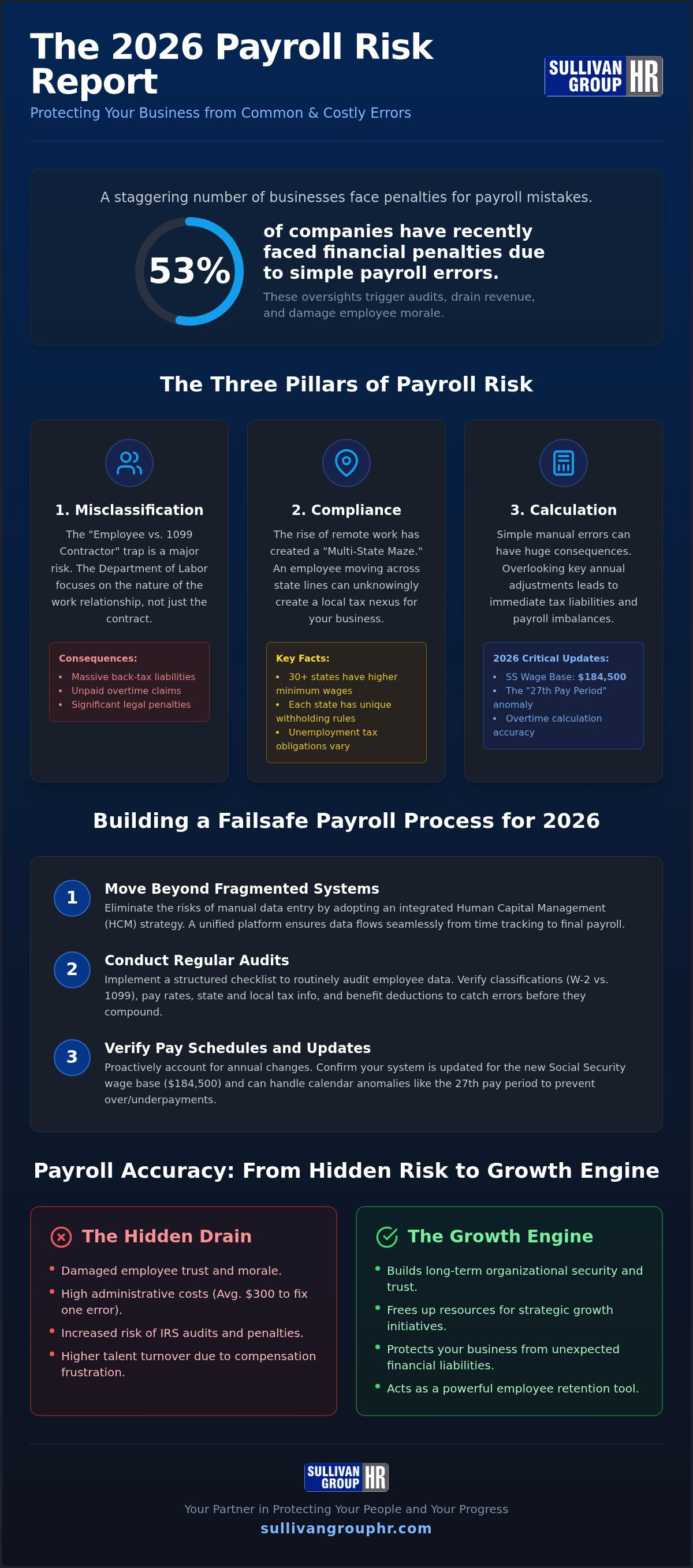
Did you know that 53% of companies recently faced penalties for payroll errors? It's a staggering figure that proves how easily a small oversight can turn into a major financial drain. When you're focused on scaling your operations, the last thing you need is an IRS audit or a dip in employee morale. Identifying the common payroll errors to avoid isn't just about staying organized; it's about protecting your legacy and your people as we move through 2026.
We understand that managing multi-state taxes and manual data entry often feels like an uphill battle. You deserve a process that offers security, efficiency, and total compliance. This article will show you how to eliminate the mistakes that trigger audits and drain your revenue. We'll preview the critical shifts for the year, including the Social Security wage base increase to $184,500 and the unique 27th pay period anomaly, so you can maintain a steady, reliable beat for your business.
Key Takeaways
- Understand how payroll accuracy acts as a growth engine by protecting employee morale and your company culture.
- Identify the common payroll errors to avoid, specifically focusing on contractor misclassification and multi-state tax compliance.
- Are your systems fragmented? Move beyond separate software toward an integrated HCM strategy to eliminate the risks of manual data entry.
- Build a failsafe process for 2026 using a structured checklist to audit employee data and verify pay schedules.
- Discover how combining local expertise with the isolved platform provides a secure, protective approach to payroll administration.
The Invisible Cost of Payroll Mistakes: Why Accuracy is Your Growth Engine
Is your payroll process a silent engine for growth or a hidden drain on your resources? Many leaders view payroll as a simple transactional task. In reality, it's the heartbeat of your organization. True accuracy goes far beyond just "getting checks out on time." It involves a precise alignment of time tracking, tax calculations, and regulatory adherence. When you identify the common payroll errors to avoid, you aren't just checking a box. You're securing the financial health of your entire enterprise.
Mistakes trigger a chain reaction. When an employee sees an incorrect figure, their confidence in your brand's stability drops. This isn't just about money. It's about the psychological safety of your workforce. This frustration doesn't stay quiet; it spreads through your culture, impacting productivity and morale. Research shows that fixing a single overtime miscalculation costs an average of $300 in administrative time. That's a high price for a preventable oversight that could have been caught with better systems.
The Three-Part Impact: Accuracy, Compliance, and Security
To master the fundamentals of payroll, you must balance three critical pillars. First is accuracy. Every dollar must match the hours worked. Second is compliance. With 30 states and Washington D.C. maintaining minimum wages higher than the federal level, navigating the labyrinth of regulations is essential. Finally, there's security. In 2026, protecting sensitive employee data from cyber threats is a non-negotiable part of your administrative duty. These three elements form a protective shield around your business assets.
Payroll as a Retention Tool
Why do employees stay? They stay because they feel valued and secure. Consistent, error-free pay builds long-term organizational security. If your team is constantly worried about their compensation, they'll start looking for the exit. The high cost of replacing talent lost to "payroll frustration" can cripple a growing company. By utilizing integrated workforce management solutions, you foster transparency and trust. This unified approach ensures that compensation is always a source of stability, never a point of contention.
In 2026, the IRS is watching closer than ever. The Social Security wage base has increased to $184,500, and missing these updates leads to expensive back taxes and penalties. Since 53% of companies have recently faced penalties for payroll errors, the stakes are high. A unified HCM strategy protects you from these risks. It transforms a vulnerable administrative function into a resilient foundation for your business growth.
The Three Pillars of Payroll Risk: Classification, Compliance, and Calculation
What are the most significant threats to your business stability? They often hide in your payroll ledger. To build a resilient organization, you must master the three pillars of risk: classification, compliance, and calculation. These areas represent the most common payroll errors to avoid if you want to prevent revenue drain and maintain employee trust. When these pillars crumble, the financial and legal consequences can be devastating for a growing company.
Errors in these categories aren't just administrative hiccups. They are structural risks. For example, failing to account for the 2026 "27th pay period" anomaly can lead to significant overpayments if your systems aren't adjusted. Likewise, missing the new Social Security wage base of $184,500 creates immediate tax liabilities. Managing these complexities requires a proactive approach that prioritizes precision over speed.
The Independent Contractor vs. Employee Trap
Many owners still believe that a signed contract is enough to define a worker as a 1099 contractor. In 2026, this is a dangerous misconception. The Department of Labor focuses heavily on the actual nature of the work relationship, not just the paperwork. If you exercise significant control over how, when, and where the work is done, that person is likely an employee. Misclassifying an employee can lead to massive back-tax liabilities and unpaid overtime claims. To stay protected, it's vital to avoid misclassification by conducting regular audits of your workforce.
Multi-State Compliance in a National Workforce
The shift to remote work has created a "Remote Work Trap" for many HR departments. If an employee moves across state lines, you may unknowingly create a local tax nexus. This means you're suddenly responsible for state-specific withholding, unemployment taxes, and local sick leave laws. Managing these variables manually is no longer viable for national growth. You need a system that automatically updates tax tables based on where the work is actually performed. Relying on outdated spreadsheets for multi-state taxes is a recipe for IRS penalties.
Calculation errors often occur during the "Gross-to-Net" process. Are you using the correct federal income tax withholding methods for bonuses and overtime? Don't forget about garnishments and benefits deductions. These "forgotten" items are a frequent trigger for audits. A single missed garnishment order can make your business liable for the employee's entire debt. Ensuring these calculations are handled correctly is a core part of professional payroll administration.
DIY vs. Integrated HCM: Evaluating Your Payroll Strategy
Are you still treating payroll like a part-time administrative task? This "Simple Task" myth is one of the most dangerous roadblocks to business growth. In 2026, payroll has evolved into a complex risk management function that requires constant vigilance. If your strategy relies on fragmented systems where timekeeping and payroll software operate in silos, you are leaving your business vulnerable. Every time data is manually moved from one platform to another, the door opens for the very common payroll errors to avoid that we've identified.
Unified platforms solve this by eliminating "placeholder" data and transcription mistakes. When your systems are integrated, information flows seamlessly from the time clock to the paycheck. This creates a resilient foundation for your operations. Investing in professional payroll administration outsourcing isn't just an expense. It's a strategic move that provides a measurable return by preventing costly compliance failures and freeing your leadership team to focus on talent development.
The Hidden Costs of Manual Entry
Human data transcription has an inherent error rate that can quietly drain your revenue. Beyond simple typos, many small teams suffer from "one-person knowledge" dependency. If your entire payroll process lives in the head of a single employee or within a specific spreadsheet, your organization is one absence away from a crisis. Automation provides a protective shield against these vulnerabilities. It replaces manual calculations with reliable logic, ensuring that your data remains accurate even as your headcount grows.
Integrated HCM: The isolved Advantage
Strategic growth requires a shift from transactional payroll to a unified Human Capital Management approach. The isolved platform has become the 2026 gold standard for mid-market businesses because it provides a single source of truth. When your time, attendance, and benefits management live in one place, the "Gross-to-Net" gap narrows. You no longer have to worry about whether a new hire's data was correctly synced across three different tools. This integrated technology, combined with our "handshake" philosophy of personal support, ensures your payroll is always a source of stability.
Does your current setup feel like a patchwork of software and spreadsheets? It's time to trade that anxiety for the peace of mind that comes with a unified strategy. By aligning your technology with expert oversight, you protect your progress and your people simultaneously.
Designing a Failsafe Payroll Process: A 2026 Checklist
How do you transform a complex administrative burden into a predictable, error-free routine? You build a failsafe process. Having a structured, repeatable checklist is your most effective defense against the common payroll errors to avoid. It shifts your team from a reactive state of "putting out fires" to a proactive state of total organizational control. By standardizing your workflow, you create a protective layer that preserves your revenue and employee trust.
- Audit your data: Validate Social Security numbers and I-9 status for every team member. Incorrect data entry at the onboarding stage is a frequent trigger for IRS inquiries.
- Review your calendar: Establish consistent pay schedules and strict submission deadlines. Ensure your system is adjusted for the unique 2026 "27th pay period" anomaly to prevent overpayment.
- Verify your deductions: Perform a spot check on benefit premiums and tax withholdings. With the 2026 Social Security wage base set at $184,500, ensuring your system caps these taxes correctly is vital.
- Document your policies: Create a clear Standard Operating Procedure (SOP) for your payroll cycle. This eliminates "one-person knowledge" dependency and ensures continuity during staff transitions.
Internal Audits and Regulatory Updates
Waiting until year-end to find a mistake is a recipe for disaster. We recommend performing quarterly internal audits to catch discrepancies before they become systemic failures. These checks should look for misclassified contractors, outdated withholding certificates, and unclaimed wages. Staying current with 2026 federal tax law changes requires constant vigilance. If you feel overwhelmed by these shifting requirements, consulting with a human capital management expert can provide the clarity and security your business needs.
Streamlining Time and Attendance
Accuracy begins at the clock. Manual rounding and "time theft" can quietly erode your profit margins. Integrating your timekeeping directly into your payroll software eliminates the need for manual transcription, which is where many errors occur. Employee self-service portals also play a major role in data accuracy. When employees can review their own hours and update their personal information, it creates a transparent environment that fosters long-term retention. This integrated approach ensures that every minute worked is a minute accurately paid.
Is your current process truly failsafe? If you want to eliminate the stress of tax season and protect your business growth, it's time to professionalize your payroll administration with an ally who understands your specific needs and can help you navigate these regulatory hurdles with confidence.
Sullivan Group HR: Protecting Your People and Your Progress
At Sullivan Group HR, we believe your business growth shouldn't be stalled by administrative friction. You've worked hard to build your legacy. Why let a preventable tax penalty or a calculation error jeopardize that progress? Our "Handshake" philosophy represents a commitment to personal expertise with a national reach. We don't just hand you a login and walk away. We stand beside you as a reliable, no-nonsense authority who understands the weight of your professional potential. Our team acts as a protective shield for your assets, allowing you to focus on what you do best.
We leverage the industry-leading isolved HCM platform to ensure your payroll administration is precise. Technology is our engine, but human wisdom is our navigator. While automated systems are excellent at crunching numbers, they don't always understand the nuances of your specific territory or the unique needs of your team. By combining high-tech tools with high-touch consulting, we help you navigate the most common payroll errors to avoid before they impact your bottom line. We focus on the "human" in human capital management, ensuring your people feel valued and your assets remain safe.
The Sullivan Group HR Difference
What sets us apart? It's the way we combine the isolved People Cloud with human-centric support. We move beyond the transactional nature of payroll to focus on long-term organizational security. This means managing HR risk management proactively rather than reactively. Our framework focuses on three key pillars: Acquisition, Compensation, and Security. This lifecycle approach ensures that every step of your professional relationship with your employees is documented, compliant, and protected from modern regulatory threats.
Ready to Eliminate Payroll Stress?
Transitioning to an outsourced model shouldn't be a source of anxiety. We've designed our implementation process to be seamless and non-disruptive. You gain the peace of mind that comes with professional tax filing and the assurance that your 2026 compliance is handled by experts. No more staying up late worrying about multi-state nexus or changing overtime thresholds. We handle the administrative burden so you can get back to the work you love. Whether it's managing the 27th pay period anomaly or adjusting to the $184,500 Social Security wage base, we have you covered.
Take the first step toward a more secure professional future. You deserve a partner who values people over systems and views your success as the primary metric of our own. Let's work together to protect your progress and your people. It's time to trade administrative anxiety for reliable advocacy.
Securing Your Business Legacy for 2026 and Beyond
Are you ready to trade the anxiety of tax season for the confidence of a compliant, automated process? We've explored how accuracy acts as a growth engine by protecting your culture and your bottom line. We've also identified the common payroll errors to avoid, from the risks of multi-state tax nexus to the dangers of manual data entry. By shifting from fragmented spreadsheets to a unified strategy, you ensure that your compensation process remains a source of stability rather than a structural risk.
Your focus should be on scaling your operations and developing your talent. With over 25 years of HR expertise and national compliance coverage, we provide the protective partnership you need to navigate a complex regulatory world. You don't have to manage these burdens alone. Protect your growth with professional payroll administration from Sullivan Group HR and gain access to the industry-leading isolved HCM platform today. It's time to professionalize your workflow and protect your people. Your future success is our primary metric, and we're here to help you reach your full professional potential.
Frequently Asked Questions
What are the most common payroll tax errors for small businesses?
The most common payroll tax errors for small businesses include missing the Social Security wage base limit of $184,500 and failing to apply the additional 0.9% Medicare tax for high earners. Other frequent mistakes involve late deposits and incorrect state unemployment tax credits. These are the primary common payroll errors to avoid if you want to prevent sudden revenue loss. Staying vigilant with your tax calendar is the best way to protect your business assets.
How much are the IRS penalties for payroll mistakes in 2026?
IRS penalties for payroll mistakes in 2026 are generally tiered based on the length of the delay. Deposits that are 1 to 5 days late typically incur a 2% penalty, while those 6 to 15 days late face a 5% charge. If your deposit is more than 15 days late, the penalty often jumps to 10%. These costs compound quickly, making professional oversight a vital investment for your long term organizational security and financial health.
Can an employer be sued for a payroll mistake?
Yes, an employer can be sued for payroll mistakes, particularly those involving unpaid overtime or minimum wage violations. Under the Fair Labor Standards Act, employees have the right to seek back pay and liquidated damages for calculation errors. Legal defense costs and court mandated settlements can cripple a growing company. This is why maintaining an accurate, documented payroll process is essential for your professional peace of mind and your brand reputation.
How do I fix a payroll error after the checks have been issued?
To fix a payroll error after checks are issued, you must first determine if the mistake was an underpayment or an overpayment. For underpayments, you should issue a manual check immediately to maintain employee trust. For overpayments, you'll need to consult state laws before attempting a deduction from future pay. Documenting this correction is a critical step in your common payroll errors to avoid checklist to ensure your ledgers remain transparent for audits.
What is the difference between a payroll error and payroll fraud?
The difference between a payroll error and payroll fraud is primarily intent. An error is an unintentional mistake, such as a typo or a misapplied tax rate. Fraud involves deliberate deception, such as creating ghost employees or intentional time theft for personal gain. While both result in financial loss, fraud often carries severe criminal charges. Implementing a unified HCM strategy with strict internal controls is the most effective way to detect both unintentional and malicious activity.
Is there a grace period for fixing payroll mistakes before penalties apply?
There is no official grace period for fixing payroll mistakes before penalties apply, as the IRS expects deposits to be made on time. However, the IRS may waive penalties if you can demonstrate reasonable cause for the error. This usually requires proof that you exercised ordinary business care but were still unable to meet the requirement. Proactive communication with tax authorities and immediate correction of the mistake are your best strategies for minimizing financial impact.
How can I prevent misclassifying employees as independent contractors?
You can prevent misclassifying employees as independent contractors by using the Department of Labor's economic reality test. Focus on the level of control you have over the worker and whether the work is an integral part of your business. If you provide the tools, set the schedule, and direct the methods, the worker is likely an employee. Conducting regular internal audits of your 1099 contracts is a protective measure that preserves your business legacy.
Does using an HCM platform like isolved prevent all payroll errors?
While an HCM platform like isolved significantly reduces the risk of calculation and transcription mistakes, it doesn't prevent all payroll errors. Technology is a powerful tool for automation and security, but it still requires accurate initial data entry and professional oversight. Combining industry leading software with our handshake philosophy of expert support creates a failsafe environment. This unified approach ensures that your payroll administration remains precise, compliant, and supportive of your overall business growth.


