
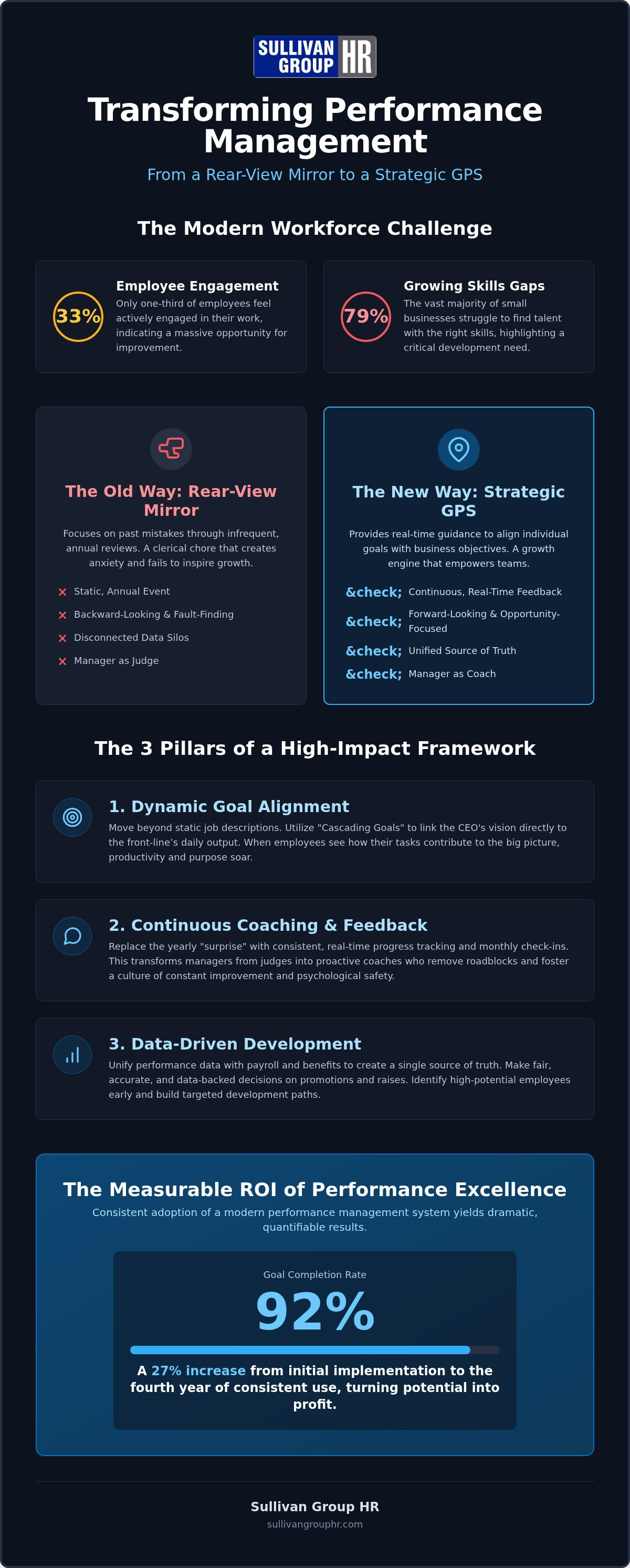
What if your annual review process actually inspired your team instead of draining them? Currently, only 33% of employees feel engaged at work, while 79% of small businesses report growing skills gaps. It's frustrating to watch top talent walk out the door because they don't see a clear path forward. You likely feel that your current performance management system is more of a clerical chore than a growth engine. We understand the pressure of managing disconnected software that keeps your payroll, benefits, and people data in separate silos. It's time to stop just monitoring metrics and start coaching for excellence.
Sullivan Group HR is here to help you bridge the gap between sophisticated software and human strategy. You'll learn how to transform employee output into a strategic competitive advantage by blending the isolved platform with intentional coaching. This guide explores how to lower turnover, align individual goals with business growth, and unify your data into a single source of truth. We'll show you how to move from spreadsheet hell to a streamlined framework that secures your team's future, empowers your managers, and drives measurable results.
Key Takeaways
- Discover how a modern performance management system functions as a GPS for your organization's future rather than a rear-view mirror.
- Identify the three essential pillars for building a high-impact framework that aligns individual output with your strategic business goals.
- Learn to eliminate "spreadsheet hell" by integrating your performance data with payroll and benefits for a unified view of your workforce.
- Follow a clear, five-step blueprint to audit your current HR infrastructure and define a "North Star" for talent development.
- See how the combination of isolved technology and expert coaching from Sullivan Group HR can turn employee potential into a lasting competitive edge.
What is a Performance Management System in the 2026 Workplace?
Is your current process a rear-view mirror or a GPS for your company's future? Most business owners find themselves stuck in the past. They spend hours looking back at the last twelve months to find faults, rather than looking forward to find opportunities. A modern performance management system acts as a strategic GPS. It provides real-time guidance to ensure every team member reaches their destination safely and efficiently. This isn't just a digital form for HR to file away. It's a structured, technology-enabled framework designed to align individual goals with your broader business objectives. It creates clarity, fosters growth, and secures results.
This shift in perspective is central to understanding what is human capital management in today's competitive market. HCM isn't just a database of employee names; it's the strategic orchestration of your people's potential. In 2026, we've moved past the era of performance management as a static, annual event. We've entered the age of performance activation. This means your system must be alive, responsive, and deeply integrated into the daily flow of work. It moves your team from a state of being monitored to a state of being empowered.
The Evolution: From Reviews to Results
The traditional performance appraisal is essentially dead in the modern labor market. Employees don't want to wait 365 days to find out how they're doing. They crave immediate, actionable feedback that helps them improve in the moment. Real-time feedback loops don't just improve output; they foster a deep sense of security and belonging. When your team knows exactly where they stand, they stop worrying about their job security and start focusing on their professional legacy. This transparency is the bedrock of long-term organizational stability. It transforms the manager from a judge into a coach who identifies hurdles before they become roadblocks.
The Measurable ROI of Performance Excellence
High turnover is an expensive symptom of a broken system. By identifying High-Potential employees early, you can protect your most valuable assets and reduce the staggering costs of replacement. A unified system allows you to link performance data directly to payroll administration outsourcing. This ensures merit increases are accurate, fair, and driven by hard data rather than gut feelings. According to the PerformYard 2025 State of Performance Management Report, goal completion rates can rise as high as 92% by the fourth year of consistent adoption. That's a 27% increase from the initial stages of implementation. When you build a culture of accountability through unified data, revenue growth naturally follows as a byproduct of excellence.
The Three Pillars of a High-Impact Performance Framework
Does your performance strategy live in a dusty binder or in your team's daily actions? A successful performance management system requires more than just a document; it requires a lifecycle approach. We focus on three core pillars: Goal Alignment, Continuous Coaching, and Data-Driven Development. These pillars ensure your team is rowing in the same direction, your managers are empowered mentors, and your analytics guide every career path. By treating performance as a continuous journey rather than a destination, you create a resilient culture that can weather any market shift.
Dynamic Goal Setting and Alignment
Static job descriptions are relics of a slower era. Today, you need agile, project-based goals that shift with your market. Within the isolved platform, employees see exactly how their daily tasks contribute to the organization's big picture. We utilize the "Cascading Goals" method. This links the CEO’s vision directly to the front-line’s daily output. When everyone understands their "why," productivity becomes a natural outcome rather than a forced metric. This alignment protects your business from wasted effort and ensures that every hour worked moves the needle on your primary objectives.
Continuous Feedback Loops
Why wait for a yearly "surprise" when you can have monthly check-ins? Real-time progress tracking is the hallmark of modern workforce management solutions. As discussed in the Harvard Business Review article Reinventing Performance Management, the focus has shifted toward frequent, forward-looking conversations. Performance activation is the proactive alternative to traditional management; it fuels growth in the moment. This steady rhythm builds trust and eliminates the anxiety associated with high-stakes annual reviews. It allows managers to act as allies who solve problems rather than judges who merely document them.
Professional Development as a Retention Tool
Are you using performance data to build your future leaders? Linking performance gaps to specific training modules turns a critique into a career path. You can even tie benefits management solutions, such as tuition reimbursement, to specific performance milestones. This approach creates a clear succession plan for every critical role in your organization. It gives your top performers a reason to stay and grow with you. If you want to move beyond basic tracking, partnering with an HR expert can help you design a development framework that secures your team's long-term potential.
Why Disconnected HR Tech Fails Your Performance Strategy
Are you still chasing data across multiple tabs and disconnected files? Managing your team in "spreadsheet hell" doesn't just waste time; it creates dangerous blind spots. To be effective, your performance management system cannot exist on an island. It must communicate with your payroll, benefits, and time-tracking data to provide a complete picture of your organization's health. When these systems don't talk, your strategy suffers from fragmented insights and delayed reactions. You end up reacting to problems after they've already cost you money and talent.
According to the U.S. Department of Commerce performance management system definition, these frameworks are designed to be systematic and integrated. Without that integration, you're just guessing. Sullivan Group HR utilizes the isolved People Cloud to create a "single version of the truth" for your entire workforce. This unified platform ensures that a performance review in one department immediately informs the compensation adjustment in another. It creates a steady, reliable beat for your business operations.
The Power of Unified HCM
Efficiency starts the moment a candidate applies. By centralizing applicant tracking and onboarding with your performance data, you create a seamless journey for new hires. This integration reduces administrative friction, allowing your managers to focus on coaching rather than clerical work. You'll eliminate the manual entry errors that often occur when moving data between performance reviews and payroll updates. This structure minimizes your cognitive load, making daunting administrative tasks feel organized and manageable.
Workforce Analytics: The GPS for Your Talent
Think of analytics as the GPS for your talent strategy. Are your top performers at risk of burnout? You can't tell from a static document. Unified data allows you to spot turnover trends before they become an expensive crisis. You can measure the direct correlation between your training investments and actual output. Most importantly, data-driven insights help remove human bias from the promotion and reward process. This ensures that rewards are based on merit, fostering a culture of fairness and long-term organizational security. It positions you as a reliable authority who values people over automated, faceless processes.
5 Steps to Implementing Your Organizational Talent Blueprint
- Step 1: Define Your North Star. Align your talent goals with your three-year business objectives. If you don't know where you're going, your team won't either.
- Step 2: Audit Your Infrastructure. Determine if your current tech is helping or hurting your progress. This is the time to eliminate "spreadsheet hell" and look toward a unified platform.
- Step 3: Empower Your Coaches. Train your managers on the new framework. They need to lead with confidence, moving from monitors to mentors.
- Step 4: Launch and Iterate. Deploy the system with a pilot group. Use their feedback to iron out any wrinkles before a full-scale rollout.
- Step 5: Measure the ROI. Track KPIs like retention rates and revenue per employee. Data proves the value of your strategic shift.
Aligning Vision with People
If your company grew by 25% tomorrow, do you have the leadership to handle it? Rapid growth requires more than just more hands on deck; it requires a "culture add" framework for hiring and performance. You must standardize the employee experience across your remote and hybrid teams. This ensures every team member, regardless of their physical location, feels connected to the company's mission. A unified approach protects your organizational security by keeping everyone focused on the same high-level objectives.
Training Managers to Lead
Managers don't leave companies; they leave managers. We help you change this narrative by providing your leaders with the tools for instant recognition and rewards. When managers have the right tech, they can provide consistent feedback across all departments without the administrative burden. This clarity builds trust and professional rigor. It transforms the workplace into an environment of reliable advocacy where every employee knows their path to success is clear and supported. If you're ready to start this journey, partnering with Sullivan Group HR provides the expert coaching you need to implement these steps with precision.
Partnering for Potential: How Sullivan Group HR Elevates Your Strategy
Why struggle with implementation when you can have a dedicated partner? Building a high-performance culture is a complex undertaking that requires more than just a software login. Sullivan Group HR provides the perfect marriage of isolved technology and expert HR consulting. We act as your strategic partner, bridging the gap between sophisticated software and actual daily execution. This collaboration ensures your performance management system isn't just a digital tool; it's a living, breathing part of your business strategy. We help you move beyond the transactional and toward a long-term relationship built on results.
Protecting your organizational growth is our primary mission. A robust framework does more than track individual goals; it safeguards your entire operation through comprehensive HR risk management. We help you navigate the nuances of modern compliance and employee relations, ensuring your talent strategy remains both legal and effective. It's about creating a secure, stable environment where your business can thrive without the weight of administrative burdens. Our hard-earned wisdom becomes your greatest asset in a volatile market.
Beyond the Software: The Sullivan Coach Identity
Software provides the data, but our consultants provide the wisdom to act on it. We don't believe in one-size-fits-all solutions that ignore the specific needs of your team. Instead, we develop customized performance strategies tailored to your unique business goals. Our team offers ongoing support to ensure your system evolves with the 2026 market. We focus on technology, wisdom, and evolution to keep your workforce agile. This approach fosters a sense of security for business owners who may feel overwhelmed by the pace of change. We don't just provide a service; we offer a reliable advocacy that puts your people first. To further enhance this advocacy through leadership excellence, you can learn more about Humanise Solutions and their bespoke development programmes.
Why wait for another turnover crisis to audit your performance management approach? Now is the time to evaluate how you manage, develop, and reward your people. There's a distinct peace of mind that comes from having a unified, expert-backed strategy. You deserve a partner who understands the nuances of your territory and values your success as the primary metric of their own. We're here to help you turn potential into performance and metrics into momentum. Connect with a Sullivan Group HR coach today to start your talent transformation.
Secure Your Workforce Legacy Today
Is your team ready for the challenges of 2026? We've explored how a modern performance management system moves beyond static reviews to active coaching. By aligning individual goals with your organizational vision, you create a culture of accountability and growth. Remember that unified data is your greatest ally. When your performance metrics talk to your payroll and benefits, you eliminate the friction of "spreadsheet hell" and gain the clarity needed to lead with confidence.
You don't have to navigate this transformation alone. Sullivan Group HR provides the wisdom and the tools to turn your workforce into a strategic advantage. With access to the industry-leading isolved HCM platform and our expert HR consulting, you can integrate payroll, benefits, and risk management into one truth. It's time to stop managing administrative burdens and start leading your people. Discover how Sullivan Group HR can transform your performance strategy and build a future where your team's potential is fully realized. We're here to help you succeed every step of the way.
Frequently Asked Questions
What is the difference between talent management and performance management?
Talent management is the broad umbrella that covers the entire employee lifecycle from hiring to retirement. Performance management is a specific, action-oriented framework within that lifecycle. While talent management includes broad strategies like acquisition and compensation, a performance management system focuses on aligning daily output with strategic business goals. It's the mechanism that ensures your people are growing in the right direction. Think of it as the engine that powers your overall talent strategy.
How can a mid-sized business with a limited budget implement a performance system?
You can implement an effective framework by focusing on a phased rollout. Start with your most critical departments to demonstrate value before expanding across the entire company. Partnering with a provider like Sullivan Group HR allows you to access enterprise-level technology without the massive internal overhead. This approach bridges the gap between sophisticated software and your specific budget constraints. It's about building a steady, reliable foundation that grows alongside your business potential.
What are the most important KPIs for measuring performance management success?
Focus on metrics that prove organizational health. Key indicators include employee retention rates, goal completion percentages, and revenue per employee. Data from the PerformYard 2025 State of Performance Management Report shows that consistent adoption can increase goal completion by up to 27%. You should also track manager feedback frequency and internal promotion rates. These KPIs transform subjective reviews into a clear, data-driven narrative that demonstrates the tangible ROI of your workforce excellence strategy.
How does an integrated HCM platform like isolved improve performance tracking?
An integrated platform eliminates the "spreadsheet hell" that occurs when data is stored in separate silos. When your performance data is unified with payroll and benefits, you create a single version of the truth. This visibility allows managers to make accurate, data-backed decisions regarding merit increases and promotions. It reduces administrative friction and eliminates manual entry errors. You'll spend less time chasing data and more time coaching your team toward their professional potential.
Can performance management software really help with employee retention?
Clear development paths are one of the most effective tools for keeping top performers. High turnover often happens when your best people feel stagnant or unrecognized. A robust performance management system identifies high-potential employees early, allowing you to provide the growth opportunities they crave. It shifts the manager's role from a monitor to a mentor. This supportive environment fosters a deep sense of loyalty and ensures your team sees a long-term future with your organization.
What is succession planning and why is it part of a performance system?
Succession planning is the strategic process of identifying and developing internal talent to fill future leadership roles. It's a critical component of a performance system because it uses real-time data to map out career paths. Without accurate performance tracking, you're just guessing who is ready for the next level. This proactive approach protects your organizational security by ensuring you have a pipeline of prepared leaders. It turns current excellence into a long-term legacy.
How long does it take to see a return on investment from a new performance plan?
You'll likely see a reduction in administrative burden and an uptick in employee engagement within the first six months. However, the full strategic impact on revenue and goal completion often matures by the third or fourth year of consistent use. Performance activation is a marathon, not a sprint. A steady, purposeful rhythm is required to change company culture. Over time, these incremental gains compound to create a significant competitive advantage for your business.
Is isolved the right platform for multi-state performance management?
It's an ideal choice because it handles the complex compliance nuances of different geographic territories. Managing a workforce across state lines requires a platform that can navigate varied tax laws and compliance requirements. isolved acts as a localized "handshake," providing the specific expertise needed for each territory while maintaining a unified national framework. This ensures your performance standards remain consistent while your business stays safe from regional regulatory risks. It's a reliable, no-nonsense solution for growth.


