

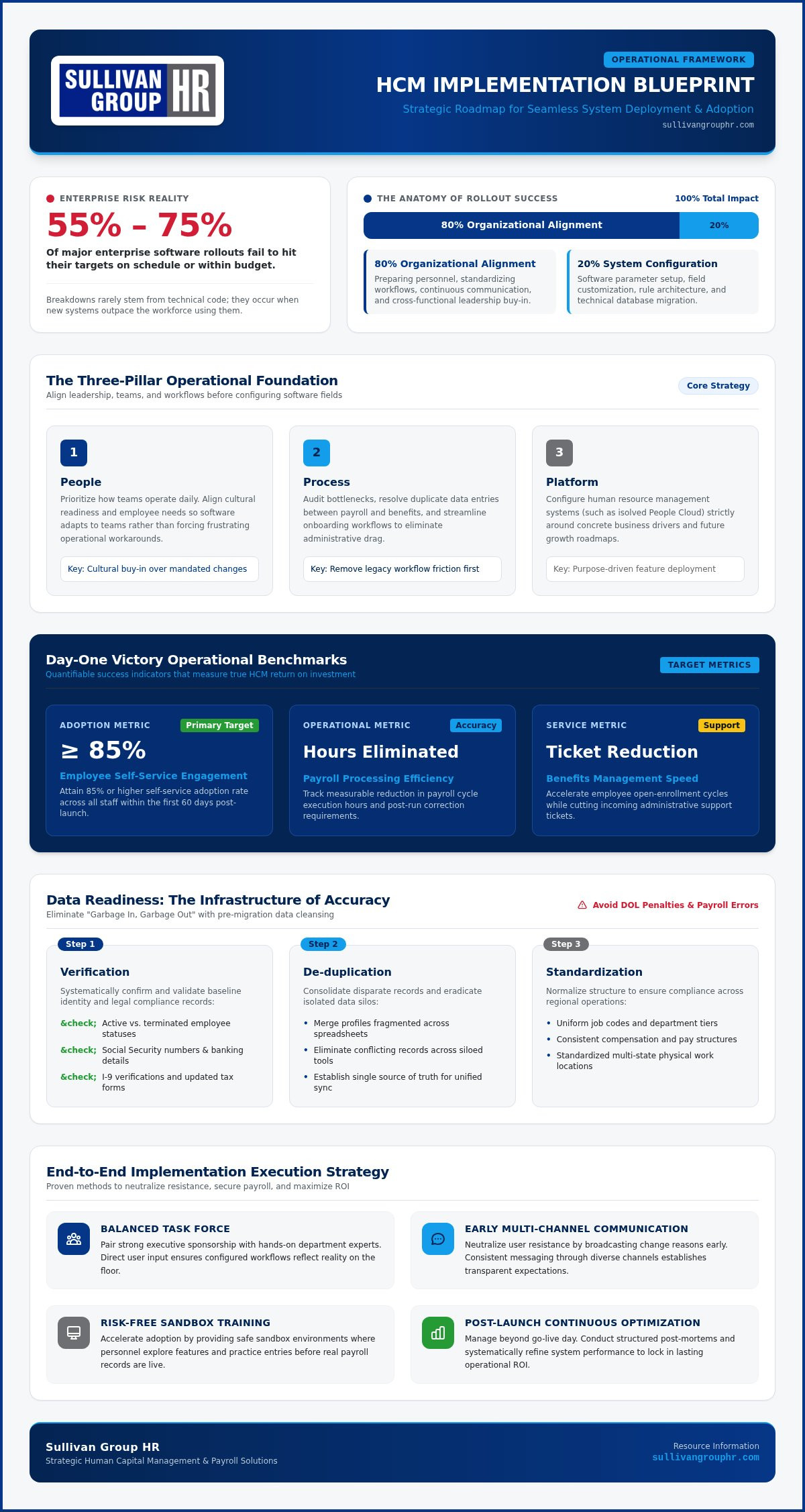
Between 55% and 75% of major enterprise software rollouts fail to hit their targets on schedule or within budget. That breakdown rarely comes down to technical code; it happens when new systems outpace the people using them. In reality, a successful rollout is 20% system configuration and 80% organizational alignment. To protect your operations, mastering hcm implementation best practices must become your top priority before you migrate a single record or configure your workflows.
If you're anxious about this transition, your concerns are completely justified. Nobody wants to risk payroll errors, timeline creep, or stubborn employee pushback against unfamiliar tools. You deserve a predictable process that builds confidence across your organization instead of creating chaos. In this guide, you'll master a battle-tested framework engineered to secure your critical data, drive rapid user adoption, and generate measurable ROI from day one. Here is your strategic roadmap to turning complex software deployment into long-term operational momentum.
Key Takeaways
- Treat your rollout as a true business transformation by aligning your people, processes, and platform before configuring software.
- Protect your payroll accuracy from day one by completing proactive data auditing and cleansing well ahead of migration.
- Applying proven hcm implementation best practices requires a balanced task force that pairs executive sponsorship with hands-on department experts.
- Neutralize user resistance and accelerate adoption by providing early multi-channel communication alongside risk-free sandbox training.
- Secure your long-term return on investment by managing past go-live day with structured post-mortems and continuous platform optimization.
Defining the Strategic Vision for HCM Success
Treating human capital management deployment as a simple IT upgrade is the quickest route to project fatigue. Modern software touches every employee touchpoint, meaning your launch is an operational transformation. Lasting success relies on a simple, three-part pillar: People, Process, and Platform. When leadership prioritizes how teams operate before configuring fields, the software adapts to your culture rather than forcing workarounds. Establishing this foundation is at the core of foundational hcm implementation best practices.
Every decision your team makes must trace back to concrete business outcomes. Are you trying to eliminate manual data entry, tighten labor compliance across regional borders, or boost talent retention? Modern human resource management systems offer vast capabilities, but deploying features without clear purpose creates confusion. Clear goals keep your timeline intact and your budget secure.
Identifying Your Core Business Drivers
Where does administrative friction slow your teams down each week? Pinpoint the bottlenecks in your existing workflows, whether they involve duplicate entry between payroll and benefits or delayed onboarding paperwork. Separate critical operational requirements from flashy, non-essential tools. Aligning your platform configuration with your 2026 organizational growth roadmap ensures your infrastructure expands smoothly as hiring accelerates.
Establishing Success Metrics and ROI
Define what Day One victory looks like with precise, verifiable operational benchmarks:
- Payroll efficiency: Track hours eliminated from payroll processing cycles and error corrections.
- Benefits management: Monitor enrollment speed and open-enrollment support ticket reductions.
- Self-service engagement: Target an 85% or higher employee self-service adoption rate within the first sixty days post-launch.
True HCM ROI is the direct intersection of reduced administrative labor costs and increased employee engagement. By grounding your strategic roadmap in these core metrics, you transform technology into a reliable engine for sustainable business momentum.
Data Readiness: The Infrastructure of Accuracy
HCM Data Readiness is the systematic process of auditing, cleansing, and validating employee information before moving it into your new environment. Moving records without scrubbing them invites disaster. In HR administration, the old rule holds true: garbage in, garbage out. Bad baseline numbers turn your launch into an operational nightmare, causing inaccurate tax withholdings, miscalculated PTO balances, and misrouted benefit deductions.
Modern workforce strategy relies on unified systems where payroll, benefits, and attendance draw from a single record. Industry models like the OPM Human Capital Framework demonstrate that strategic workforce planning depends entirely on data integrity across every operational level. A core pillar of hcm implementation best practices is reconciling historical inconsistencies months before configuration starts, ensuring your team builds upon reliable numbers.
Auditing and Cleansing Legacy Data
Clean records protect your balance sheet. Follow a disciplined, three-step audit process:
- Verification: Confirm active versus terminated statuses, correct Social Security numbers, and accurate bank details.
- De-duplication: Consolidate duplicate profiles created across fragmented spreadsheets and disparate software tools.
- Standardization: Normalize job codes, compensation structures, department tiers, and physical work locations.
Catching missing I-9 verifications or out-of-date tax forms now provides your strongest shield against painful Department of Labor penalties later. If your business is balancing regional growth or remote teams, strict data validation is essential for managing multi-state payroll without regulatory missteps.
Mapping Workflows for a Unified Platform
Migrating to a unified architecture like the isolved People Cloud lets you map the full lifecycle, from applicant tracking and onboarding to benefits and retirement. Isolated silos disappear. Instead of re-entering information across separate portals, employee data updates automatically across payroll and benefits management simultaneously. This integration eliminates redundant manual processing, preserves compliance, and lets your team focus on supporting your people. For growing organizations seeking seasoned guidance, partnering with Sullivan Group HR helps align software capabilities with practical, human-centric workflows.
Assembling Your Implementation Task Force
Technology alone never guarantees a smooth rollout. Your project succeeds or falters based on the accountability of the team guiding it. Without engaged leadership, initiatives stall in committee debates, lose funding, or drift off schedule. Executive sponsorship remains the single most accurate predictor of deployment health. When leaders actively champion the platform, they clear operational hurdles and set a confident tone across every department.
Building an agile, cross-functional committee is a core pillar of hcm implementation best practices. A strong task force unites leadership vision with daily workflow realities. Structure your internal team around three critical roles:
- Executive Sponsor: Removes organizational roadblocks, protects necessary resources, and aligns project milestones with overall business goals.
- Project Manager: Keeps delivery dates on track, manages cross-departmental tasks, and serves as the central communication hub.
- Subject Matter Experts (SMEs): Daily practitioners from payroll, benefits, and operations who test workflows, flag edge cases, and serve as departmental "Super Users."
These Super Users bridge the gap between technical design and frontline adoption. As research on effective change management strategy reveals, genuine operational transformation hinges on shifting everyday habits and building cultural trust, not just deploying new tools.
Securing Executive and Stakeholder Buy-in
Overcoming executive hesitation requires reframing software expenses into measurable investments. Rather than discussing user licenses, frame your platform upgrade as a foundation for long-term human capital management growth. Show leadership how automated compliance, unified records, and integrated payroll protect organizational assets, mitigate wage liability, and free skilled staff from manual data entry.
Choosing the Right Implementation Partner
Who guides your deployment matters just as much as the internal team you assemble. Transactional software vendors often sell software subscriptions, hand over a generic user manual, and walk away. A dedicated implementation partner serves as a true coach and ally. They learn your operational quirks, configure the system to match your real-world needs, and stand beside your team throughout testing. Combining national-scale infrastructure with personalized, human-centric consulting gives your organization steady guidance without forcing your staff to navigate technical changes alone.
The Human Factor: Change Management and Training
Employees rarely resist technology because they dislike efficiency; they resist because change sparks anxiety about competence and security. Treating training as a hurried checkbox right before go-live practically guarantees low adoption. Grounding your rollout in human-first hcm implementation best practices means managing the emotional transition with the same precision you apply to database fields.
Build your enablement around a structured, five-step path:
- Step 1: Multi-channel communication: Share timelines, expectations, and personal benefits through emails, manager huddles, and team chats.
- Step 2: Safe sandbox environments: Let staff explore the software in a practice tenant without fear of breaking live records.
- Step 3: Role-based training: Deliver targeted sessions for supervisors approving timecards versus general staff requesting time off.
- Step 4: Dedicated 30-day support: Launch an internal FAQ desk to resolve user questions within minutes.
- Step 5: Celebrate milestone wins: Recognize departments that hit early adoption targets to sustain team morale.
Overcoming Resistance to New Technology
Meet your team with an empathetic, coach-and-ally mindset rather than administrative mandates. Address the core question every worker asks: "What is in this for me?" Highlight immediate daily perks, such as reviewing shift schedules, updating direct deposits, and tracking accruals directly through a modern employee self-service portal. When employees see how self-service saves personal time, resistance dissolves into genuine ownership.
Testing and User Acceptance (UAT)
Rigorous user acceptance testing prevents launch-day surprises. Run at least two parallel payroll cycles where you process wages in both legacy software and your new environment, matching every penny to guarantee zero paycheck errors. Test the mobile interface thoroughly across varying smartphone models, especially for hourly and off-site personnel logging shifts on the go. Collect direct input from your frontline beta testers, then refine approval paths before cutting over completely.
Ready to guide your team through a seamless rollout without the stress? Connect with the specialists at Sullivan Group HR to launch your HCM deployment with confidence.
Post-Launch Optimization: From Surviving to Thriving
Go-live is not the finish line; it is simply day one of your new operational reality. Organizations often breathe a sigh of relief once the cutover happens, then abandon the system to run on autopilot. That neglect creates a painful "Day 31" reality where staff fall back on manual spreadsheets, workarounds proliferate, and original goals fade away. Leading hcm implementation best practices treat deployment as an evolving operational lifecycle rather than a static calendar date.
Schedule a formal post-mortem review roughly thirty days after your initial launch. Bring your task force back together to evaluate honest system performance:
- Which automated workflows operated smoothly, and where did managers hit snags?
- What friction points generated the highest volume of employee help tickets?
- Did payroll calculations, deduction amounts, and tax filings balance out perfectly against source data?
Once daily operations stabilize, tap into the predictive power of your unified software. Leveraging advanced workforce analytics inside the isolved People Cloud shifts your team from historical reporting to strategic forecasting. You can spot rising overtime trends, project labor capacity, and address turnover patterns before they dent profitability. Pairing these native analytics with dedicated human resources consulting ensures your policies, benefit structures, and wage practices stay completely compliant as labor laws shift across your markets.
The First 90 Days: Monitoring and Refinement
Focus your first quarter on usage depth and workflow tuning. Track system metrics closely: are remote teams logging hours accurately, and are employees updating tax forms independently? Elevate enthusiastic users into departmental mentors who can train slower adopters. Use live usage trends to simplify approval steps that cause administrative delays.
Continuous Improvement and Scaling
Modern platforms evolve continuously, releasing frequent functional improvements and automated compliance upgrades. Review these platform enhancements alongside your implementation partner each quarter. As your footprint grows into additional jurisdictions, configure your unified system to automate local wage ordinances, state paid leaves, and localized withholdings. This intentional tuning turns administrative automation into a powerful, scalable framework for sustainable expansion.
Build a Stronger Workforce Strategy for 2026
Upgrading your core workforce infrastructure is an investment in your culture, stability, and future growth. By applying proven hcm implementation best practices, you protect payroll accuracy before migration, align leadership around clear operational goals, and turn employee resistance into long-term advocacy. When you prioritize people alongside platform capabilities, software shifts from an administrative headache into a reliable engine for success.
You don't have to shoulder this transition alone. Pairing the industry-leading isolved People Cloud technology with Sullivan Group HR's expert human resources consulting gives your organization a proven track record in payroll and benefits integration. As your dedicated implementation ally, we provide the steady guidance your team needs to thrive well past launch day. Ready for a unified HCM experience? Discover how Sullivan Group HR and isolved can transform your business. Take the next step toward a seamless rollout and unlock your workforce's full potential.
Frequently Asked Questions
What is the average timeline for a successful HCM implementation?
Mid-sized deployments typically take three to six months, depending on organizational complexity and historical data readiness. A disciplined schedule moves through pre-migration discovery, system configuration, user acceptance testing, parallel payroll runs, and post-launch reviews. When managing extensive enterprise software environments and custom platform integrations, organizations often rely on dedicated quality engineering providers like Test Triangle to support rigorous technical and user acceptance testing. Rushing this sequence invites avoidable operational errors. Giving your team adequate breathing room ensures payroll rules, time-tracking policies, and benefit deduction tiers map accurately before go-live day arrives.
How do we ensure data security and HIPAA compliance during migration?
Protecting sensitive employee health and tax records requires encrypted transfer protocols and role-based access limits from start to finish. Applying proven hcm implementation best practices means signing Business Associate Agreements (BAAs), scrubbing obsolete historical files, and restricting migration access strictly to vetted project members. Never transfer unencrypted spreadsheets containing Social Security numbers or dependent health records across standard email channels during your configuration cycles.
What are the most common mistakes companies make during HCM rollout?
The most frequent pitfall is treating deployment as an isolated IT upgrade rather than an organizational shift. Companies often skip parallel payroll testing, rush data cleansing, or omit structured manager enablement. Overlooking cultural resistance creates widespread user friction. Without active executive sponsorship and clear cross-department communication, employees quickly revert to manual spreadsheets, eroding your platform's intended efficiency and reporting accuracy.
How does an HCM implementation partner differ from a software vendor?
Software vendors focus primarily on closing software sales, handing over generic documentation, and walking away. An HCM implementation partner acts as a hands-on strategic ally. Partners like Sullivan Group HR align platform configuration directly with your operational workflows, guide parallel testing, and deliver ongoing human resources consulting. You gain personalized expertise and long-term advocacy rather than an impersonal technical handoff.
Can we implement different HCM modules in phases instead of all at once?
Yes, a phased deployment is often the safest path for growing organizations. Most employers launch core payroll, time and attendance, and baseline employee records first to establish day-to-day stability. Once those critical workflows operate reliably, you can introduce applicant tracking, performance management, and automated benefits enrollment. Phasing minimizes administrative cognitive overload while keeping wage calculations and compliance intact through each transition.
How do we measure the ROI of our new HCM platform after the first year?
Evaluate return on investment by comparing verified operational hours and hard administrative costs against your pre-launch baseline. Calculate hours eliminated from manual payroll processing, open enrollment support, and routine employee inquiries. Add savings generated by avoiding wage compliance penalties and reducing paper distribution. When automated self-service handles daily requests, administrative staff can redirect valuable time toward strategic talent retention.
What should be included in an HCM change management communication plan?
An effective communication plan outlines project milestones, answers role-specific questions, and highlights practical benefits for every worker. Standard hcm implementation best practices call for multi-channel messaging, including executive emails, short video walk-throughs, and manager Q&A sessions. Be transparent about cutover dates, show staff how to log in, and clearly demonstrate how self-service tools simplify shift tracking, time-off requests, and paystub access.
How do we handle legacy data that doesn’t fit into the new system?
Archive obsolete records in secure, searchable digital storage rather than cluttering your modern system with non-conforming fields. Standardize active employee details so they match your new database architecture, retaining historical records separately to satisfy statutory tax obligations. Creating a structured archival policy protects compliance requirements without forcing legacy formatting errors, duplicate profiles, or outdated job codes into your clean production environment.


