

What if the monitoring tools you implemented to protect your bottom line are quietly driving your best employees away? When it comes to preventing time theft in the workplace, heavy-handed surveillance often backfires. Real protection doesn't come from acting like a digital warden; it comes from pairing transparent expectations with reliable, intuitive systems.
You already know the stress of watching unexplained overtime and inflated timesheets eat away at operational margins. With 75% of businesses losing revenue to unaccounted hours, accurately tracking hybrid, mobile, and on-site staff can feel overwhelming. Worse, worrying about Fair Labor Standards Act compliance during disputed hours adds needless pressure to an already demanding schedule. You shouldn't have to play detective just to ensure fair pay for an honest day's work.
In this guide, you'll discover actionable strategies to eliminate time theft, protect payroll integrity, and build a culture of accountability. We'll walk through setting enforceable timekeeping policies, deploying automated time and attendance technology, and connecting everyday hours directly into reliable payroll administration.
Key Takeaways
- Understand the true operational cost of unrecorded minutes and how clear policies lay the groundwork for preventing time theft in the workplace.
- Replace vulnerable manual honor systems with automated time and attendance technology to capture true hours worked across all job sites.
- Master communication strategies that introduce essential timekeeping controls without undermining employee trust or workplace morale.
- Eliminate manual data transfer errors by connecting daily time tracking directly to streamlined payroll administration.
- Safeguard your organization against costly compliance disputes with structured oversight and integrated human capital management solutions.
Understanding Time Theft: Common Forms and Measurable Workplace Impact
Time theft happens whenever team members receive compensation for hours they did not actually work. While conversations surrounding fair pay often focus on employer-side wage theft, unrecorded employee time loss creates an equally damaging operational burden. Most occurrences don't begin with criminal intent. Instead, subtle habits emerge from fuzzy workplace expectations, shifting casual productivity drift into routine payroll padding. Successfully preventing time theft in the workplace starts with recognizing the dividing line between an honest mental breather and systematic hour inflation.
The Many Faces of Lost Working Hours
Lost time takes multiple shapes across modern job sites. Recognizing these behaviors helps leadership address issues before they solidify into bad team habits:
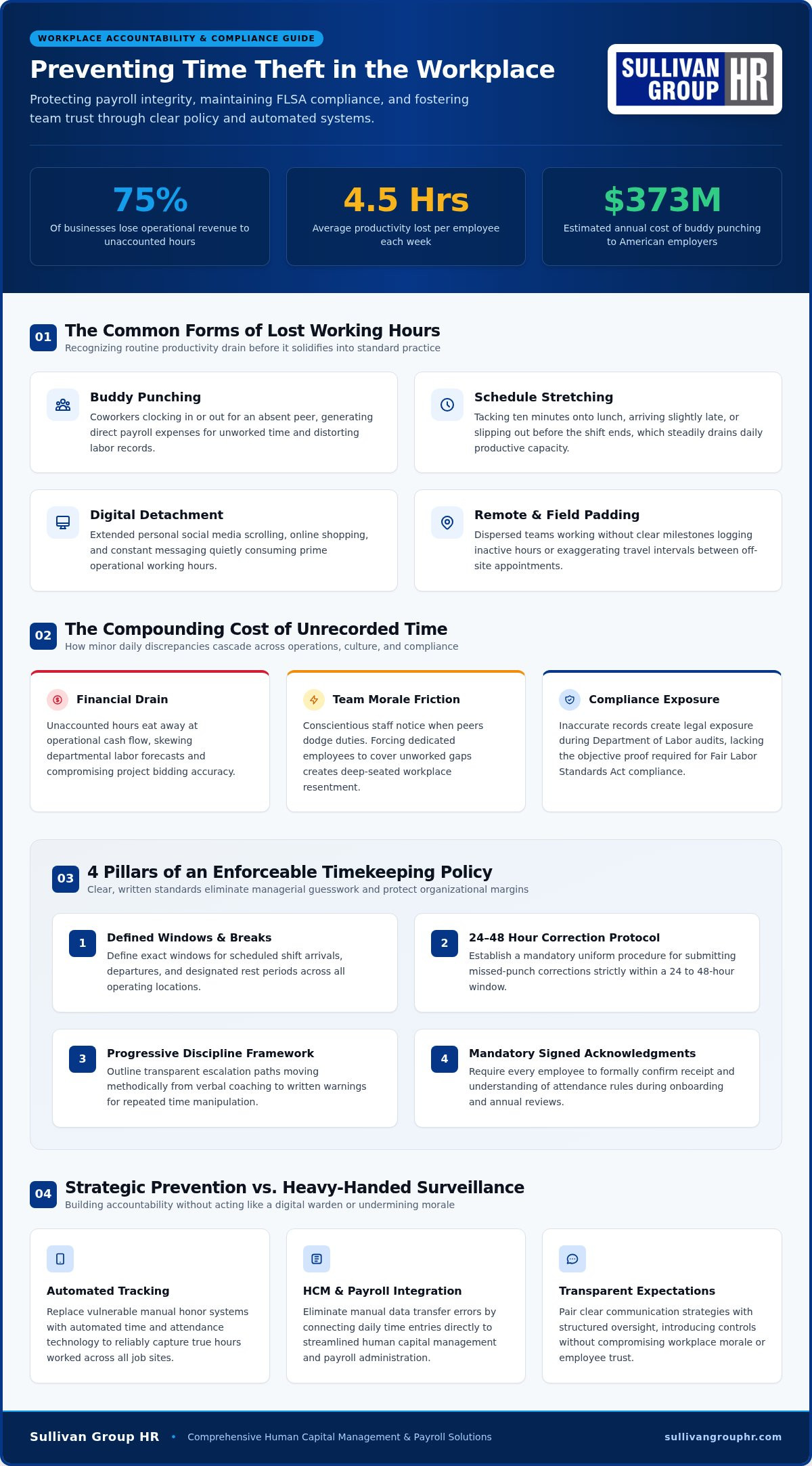
- Buddy punching: Coworkers clocking in or out for an absent peer remains a persistent issue, costing American employers an estimated $373 million every year.
- Unrecorded schedule stretching: Tacking ten minutes onto lunch, arriving late, or slipping out before the shift ends quickly drains daily productive capacity.
- Digital detachment: Extended personal social media scrolling, online shopping, and constant personal messaging quietly consume prime working hours.
- Remote and field padding: Dispersed teams working without clear milestones can easily log inactive hours or exaggerate travel time between off-site appointments.
Without clean standards, these gaps become normalized. Preventing time theft in the workplace requires identifying whether an issue stems from poor habits, flawed systems, or intentional misconduct.
The Compounding Cost to Bottom Lines and Morale
A few stolen minutes might look harmless on a single daily shift. Multiply that across your entire headcount over an entire fiscal quarter, and the financial reality becomes jarring. Research indicates the average employee loses approximately 4.5 hours of productivity each week. That unaccounted drain eats away at operational cash flow, skewing departmental labor forecasts and project bidding accuracy.
The cultural cost cuts just as deep. Conscientious, high-performing employees notice when their colleagues repeatedly dodge duties or vanish during critical project windows. Forcing dedicated staff to cover unworked gaps sparks resentment, driving down overall team engagement. Inaccurate time cards also create serious legal vulnerability during Department of Labor wage audits, leaving leadership without the defensible, objective records required to prove Fair Labor Standards Act compliance.
Creating an Airtight Time and Attendance Policy for Your Team
Technology alone cannot fix payroll padding if your rules exist only as unspoken assumptions. Clear, written expectations form your strongest frontline defense against disputed work hours. When company handbooks rely on vague language, different department managers interpret attendance rules however they see fit. That inconsistency breeds friction and exposes your business to unnecessary legal liability. A structured attendance policy integrates seamlessly into broader HR risk management practices, ensuring fairness while protecting organizational margins.
Core Components of an Enforceable Timekeeping Policy
An effective attendance policy removes ambiguity so managers don't have to guess how to handle attendance irregularities. Build your policy around these fundamental pillars:
- Shift punctuality and break expectations: Define exact windows for arrival, scheduled departures, and designated rest periods.
- Missed-punch protocols: Establish a uniform process for submitting punch corrections within 24 to 48 hours.
- Transparent progressive discipline: Outline clear escalation steps, moving from verbal coaching to written warnings, for repeated time manipulation.
- Mandatory signed acknowledgments: Require employees to confirm receipt of the policy during onboarding and annual reviews.
Taking these steps ensures operational standards remain uniform across every department. In fact, establishing clear documentation is a vital baseline for preventing time theft in the workplace without creating managerial friction.
Maintaining Strict Fair Labor Standards Act Compliance
Every internal rule you draft must respect federal and state wage statutes. Under Department of Labor guidelines on Hours Worked Under the Fair Labor Standards Act, employers must maintain meticulous records of actual time worked for all non-exempt staff. Short breaks running between 5 and 20 minutes are compensable as hours worked and cannot be deducted from timesheets.
Equally critical is avoiding automatic meal deductions. If a team member works through lunch, that time must be paid. Even when hours are unapproved or violate internal overtime rules, federal law mandates payment for all work performed. Discipline must focus on conduct rather than docking earned pay. Partnering with seasoned human resources consulting professionals can help you design protective policies that uphold strict compliance while setting transparent operational boundaries.
Modern Time Tracking Tools vs. Outdated Manual Systems
Relying on paper cards or shared spreadsheets leaves your operational budget vulnerable to constant guesswork. Honor systems sound friendly, but they inevitably invite honest memory lapses and unchecked rounding habits. Moving away from manual logging isn't about distrusting your staff; it's about eliminating operational drag. Adopting modern workforce management solutions establishes clean accountability while saving your leadership team dozens of administrative hours each pay period.
The Inherent Vulnerabilities of Paper Timecards and Spreadsheets
When workers record hours on Friday afternoon for shifts worked on Monday, precision vanishes. Most simply write down their scheduled shift times rather than actual hours worked. That speculative logging leads to inflated payroll totals without any conscious ill intent. It also forces payroll administrators to spend days manually deciphering handwriting and typing numbers into spreadsheets.
Manual sheets leave zero audit trails when supervisors or employees alter time records. This absence of verifiable history leaves employers exposed during labor disputes. Paper cards also fail mobile crews and home-based personnel. As outlined in the Washington State Auditor's Office guidance on time theft, verifying hours worked across decentralized settings demands structured, auditable tracking mechanisms rather than casual self-reporting.
Essential Capabilities of Advanced Time and Attendance Platforms
Modern cloud systems replace guesswork with objective data. When considering tools for preventing time theft in the workplace, look for features that balance security with employee convenience:
- Biometric time clocks: Facial recognition or fingerprint readers ensure the person clocking in is physically present, eliminating buddy punching.
- Mobile geofencing: Location parameters require remote technicians and off-site contractors to arrive inside an assigned job perimeter before logging hours.
- Automated threshold alerts: Real-time notifications warn managers before an employee unintentionally crosses into overtime status.
- Self-service access: Transparent digital portals let team members view accumulated hours, review historical pay records, and submit punch corrections directly.
These automated capabilities protect payroll budgets while giving honest employees total clarity over their hard-earned compensation.
How to Implement Anti-Time Theft Controls Without Ruining Morale
Dropping heavy monitoring software onto work devices overnight sends an immediate message of distrust. Employees who feel under constant suspicion pull back their discretionary effort, check out mentally, or start polishing their resumes. Preventing time theft in the workplace should never feel like a high-tech dragnet. Success comes from framing upgrades around mutual protection, payroll precision, and operational fairness. When your team sees that accurate time records protect their hard-earned overtime, adoption becomes natural rather than contentious.
Step-by-Step Rollout Strategy for Modern Timekeeping
Executing a thoughtful transition plan keeps your company culture intact while closing costly labor gaps. Move forward with this sequential roadmap:
- Phase 1: Transparent communication: Announce the initiative early. Emphasize that precision tracking ensures prompt, accurate paychecks and equal workload distribution.
- Phase 2: Hands-on onboarding: Host brief walkthroughs to demonstrate how frontline staff log hours, view accruals, and flag missed punches on mobile apps or job-site kiosks.
- Phase 3: The trial cycle: Run a grace-period payroll run. Catch user errors, troubleshoot punch delays, and coach employees on proper usage without levying penalties.
- Phase 4: Responsive support: Establish an open help desk channel so managers can rectify legitimate punch anomalies within minutes.
By moving deliberately, you replace employee skepticism with genuine collaboration.
Empowering Supervisors to Address Time Discrepancies Constructively
Frontline managers make or break your accountability standards. When suspicious attendance patterns surface, supervisors shouldn't launch into emotional accusations. Instead, train them to lead with documented facts. Having exact digital records allows managers to ask supportive, objective questions: "I noticed your badge showed a delayed arrival three times this week; what roadblock is causing that gap?"
Often, chronic lateness points to deeper operational friction like child care adjustments, transit snags, or early signs of employee burnout. Identifying root causes lets you find practical remedies while holding individuals accountable to team standards. If deliberate time manipulation continues, consistent documentation protects your organization through every phase of progressive discipline. To support your leadership team with proven managerial coaching and protective policies, explore Sullivan Group HR's human resources consulting services to align daily supervision with sound labor compliance.
Connecting Accurate Timekeeping to Full-Service HCM and Payroll
Exporting hours from disconnected punch clocks into standalone payroll spreadsheets creates an open invitation for costly errors. When attendance data sits in isolated silos, numbers get mistyped, approvals get delayed, and oversight breaks down. Successfully preventing time theft in the workplace requires closing these operational gaps permanently. Investing in professional payroll administration outsourcing bridges daily time collection directly to wage disbursement and tax filings, safeguarding your operational budget from end to end.
The Power of Unified isolved Human Capital Management
Relying on disparate point solutions drains back-office energy. Deploying an integrated human capital management platform like isolved eliminates software friction while keeping operational records airtight:
- Direct data flow: Approved time records flow automatically into payroll runs, eliminating manual transcription mistakes and double entry.
- Automated wage calculations: Pre-set platform rules automatically calculate complex shift differentials, multi-tiered overtime, and leave balances without administrative delays.
- Single employee login: Staff access their schedules, punch histories, direct deposit stubs, and employee benefits management options from one secure portal.
- Actionable labor analytics: Unified reporting delivers real-time labor cost visibility, giving leaders the accurate data needed to forecast project budgets and staffing models.
Bringing time and attendance into one unified platform ensures your payroll runs smoothly every single pay cycle.
Strategic HR Consulting to Safeguard Business Integrity
Software alone cannot resolve interpersonal friction or nuanced compliance disputes. While technology captures punch data, leadership still requires seasoned guidance to navigate complex workforce scenarios. Combining technology with dedicated human resources consulting delivers the strategic backbone your managers need.
Experienced HR consultants help craft tailored, compliant employee handbooks that clearly define expectations around punctuality, remote work, and meal breaks. They provide objective advice during wage investigations and help align daily time records with workers' compensation insurance protocols. When you unite powerful technology with seasoned guidance, you build a workplace culture founded on mutual trust. Reach out to Sullivan Group HR to protect your bottom line, streamline your payroll administration, and establish dependable operational compliance across your entire enterprise.
Take Control of Your Payroll Integrity and Team Accountability
Safeguarding your bottom line doesn't require treating your staff like suspects. Successfully preventing time theft in the workplace comes down to three essentials: transparent attendance policies, modern automated tracking, and a unified payroll process. When expectations are explicit and technology removes manual guesswork, your team gains clarity, and your operational margins stay protected.
You don't have to tackle workforce management and wage compliance alone. With decades of hands-on experience, our specialists pair industry-leading isolved human capital management technology with dedicated HR consulting and accurate payroll administration. From designing enforceable employee handbooks to mitigating Fair Labor Standards Act risks, we help you replace administrative friction with complete confidence. Protect your payroll and build an accountable workforce with Sullivan Group HR today.
Frequently Asked Questions
What legally qualifies as time theft in an everyday workplace?
Time theft legally constitutes an internal policy breach rather than a criminal offense in most workplace situations. It occurs when an employee accepts pay for unworked business time. This includes misrepresenting arrival hours, extending breaks without authorization, or engaging in excessive personal matters on company time. Because federal statutes like the FLSA require payment for all hours worked, employers address time theft through progressive discipline and policy enforcement rather than criminal charges.
Is buddy punching considered a fireable offense under standard company policies?
Yes, buddy punching can be grounds for immediate termination if your company handbook explicitly classifies deliberate falsification of business records as gross misconduct. Because it involves intentional deceit to secure unearned compensation, many organizations bypass intermediate warnings. To maintain consistency, your written policy must explicitly define buddy punching, state potential termination penalties clearly, and be signed by all employees during initial onboarding and annual policy updates.
Can employers legally track remote employees using GPS and geofencing technology?
Yes, employers can legally track remote employees using GPS and geofencing, provided tracking occurs strictly during scheduled work shifts on company time. Several states require advance written notice detailing what electronic monitoring takes place and where. When preventing time theft in the workplace across mobile or remote teams, employers must establish transparent electronic monitoring disclosures to maintain regulatory compliance and preserve employee trust while confirming on-site arrival.
How does modern time and attendance software prevent timecard manipulation?
Modern time and attendance software prevents timecard manipulation by capturing verified punch events in real time. Systems utilize biometric authentication, photo capture, and mobile GPS geofencing to ensure the correct employee is physically present at the approved work location. Automated digital audit logs track every punch alteration, timestamping managerial edits. This technology removes retroactive self-reporting, eliminating rounding errors and unauthorized schedule stretching before payroll processing begins.
What is the most effective way to confront an employee about time theft?
The most effective confrontation relies on objective system data rather than emotional accusations. Meet with the employee privately and present specific digital punch logs alongside scheduled expectations. Ask open-ended questions to explore whether unresolved workload roadblocks, commute issues, or personal emergencies caused the discrepancy. Document the entire discussion objectively, outline clear behavioral standards moving forward, and clarify the progressive discipline steps that will follow if attendance issues persist.
Can an employer withhold an employee paycheck to recover stolen time?
No, employers cannot withhold or dock a non-exempt employee's paycheck to recover losses from suspected time theft. The Fair Labor Standards Act strictly mandates that employers pay employees for all hours actually worked, regardless of conduct issues. Docking earned pay invites severe regulatory fines and unpaid wage lawsuits. Disciplinary action for policy violations must involve administrative reprimands, suspension, or employment termination rather than paycheck deductions.
How does integrating time tracking with isolved improve overall payroll accuracy?
Integrating time tracking directly into the isolved human capital management platform eliminates manual data imports between disconnected systems. Approved employee punch records, meal breaks, and PTO requests flow straight into payroll administration without transcription errors. The platform automatically applies complex overtime calculations, shift premiums, and multi-state tax rules. This seamless connection plays an essential role in preventing time theft in the workplace while protecting your operational payroll budget.


