

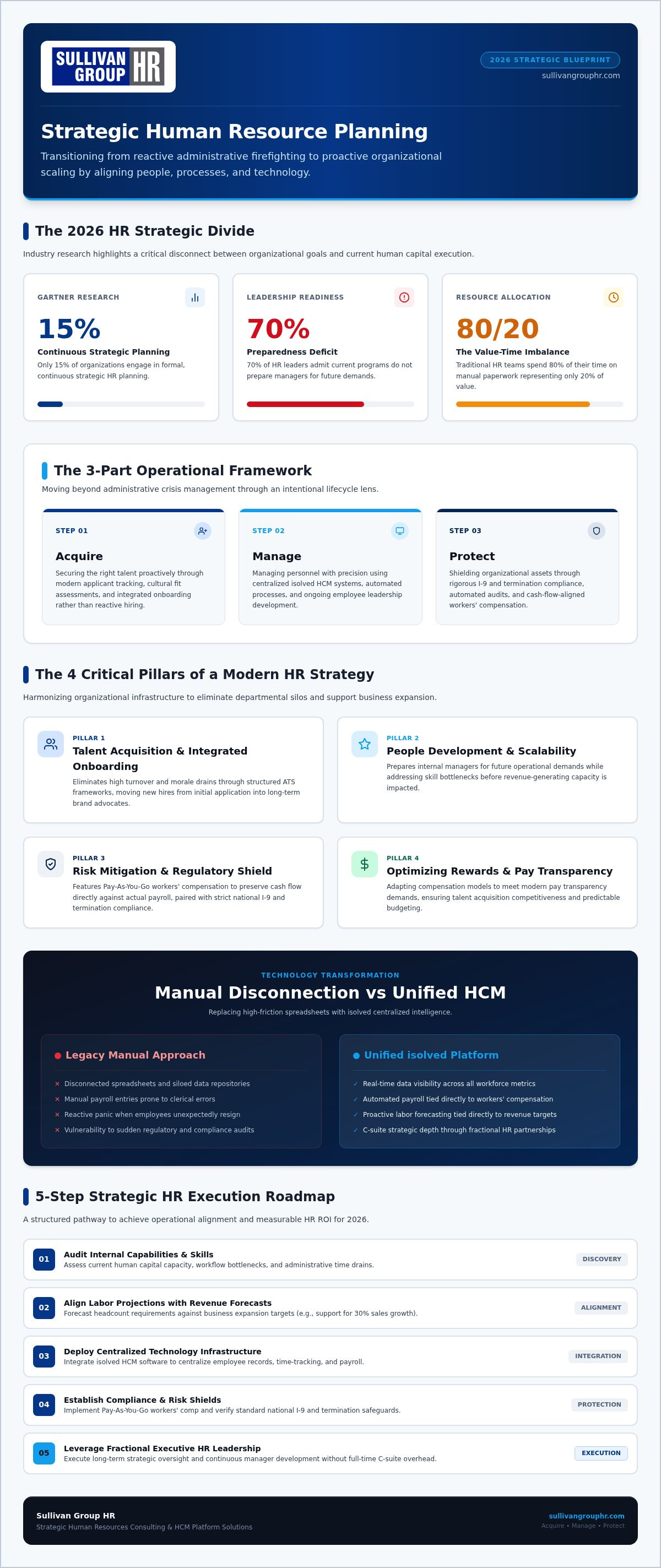
Did you know that according to Gartner, only 15% of organizations engage in formal, continuous strategic human resource planning? It's a staggering gap, especially when 70% of HR leaders admit their current programs aren't preparing managers for future demands. You likely feel the daily friction of high employee turnover, the frustration of manual tasks, or the quiet fear of a compliance audit. It's common to see HR as a necessary administrative burden rather than a competitive advantage.
We're here to change that perspective together. You can move from reactive firefighting to proactive growth by aligning your people, processes, and technology. This guide provides a clear roadmap for 2026 to help you automate administrative hurdles, secure a stable workforce, and see a clear ROI on your HR investments. We'll explore how the isolved platform powers strategic data, why pay transparency is changing talent acquisition, and how to build a workforce that scales with your vision. It's time to stop managing spreadsheets and start leading people.
Key Takeaways
- Learn why shifting from administrative tasks to strategic human resource planning is the essential bridge between your current team and your 2026 growth goals.
- Discover how to transform talent acquisition from reactive hiring into a proactive engine that uses advanced applicant tracking to find the right cultural fit.
- Replace disconnected spreadsheets with a unified isolved HCM platform to gain the real-time data visibility required for confident, strategic decision-making.
- Follow a proven five-step roadmap to audit your internal capabilities and align your labor requirements with your long-term business objectives.
- Explore how a fractional HR partnership provides executive-level expertise and automated processes to drive a clear ROI on your people investments.
What is Strategic Human Resource Planning in 2026?
Think of your business as an engine. You wouldn't expect it to run without fuel, oil, or regular maintenance, yet many leaders treat their workforce as an afterthought. In 2026, strategic human resource planning is the intentional process of anticipating and providing for the movement of people into, within, and out of your organization. It's the difference between having a team that just shows up and a team that drives you toward your goals.
The days of HR being a back-office filing department are over. Shifting from administrative tasks to strategic oversight is no longer optional if you want to scale. When you lean into a strategic human resource planning framework, you move away from reactive firefighting. You stop gasping for air every time an employee quits and start building a resilient infrastructure. We view this through a three-part lens: Acquire, Manage, and Protect. By securing the right talent, managing them with precision, and protecting your business from compliance risks, you reclaim the executive time usually wasted on manual crises.
The Evolution of HR: From Paperwork to Partnership
Traditional HR models often collapse in the high-velocity economy of 2026. Static job descriptions and manual payroll entries can't keep pace with shifting regulations and talent shortages. Is your HR team spending 80% of their time on 20% of the value? If they're buried in paperwork, they aren't helping you grow. This is where a fractional HR partner becomes a mid-market secret weapon. By leveraging expert Human Resources Consulting and the isolved platform, you get the strategic depth of a C-suite executive without the full-time headcount cost. It's about moving from a transactional vendor to a long-term partnership that values people over systems.
Aligning Human Capital with 2026 Business Objectives
For organizations in specialized sectors like behavioral health, staying informed on industry-specific management trends is essential; resources such as catalystbhconsulting.com provide tailored insights that can help refine your strategic approach.
Your recruitment targets shouldn't exist in a vacuum. They must link directly to your revenue forecasts. If you plan to increase sales by 30%, do you have the customer support and production capacity to handle it? Strategic planning identifies these skills gaps before they become bottlenecks that stall your momentum. It allows you to forecast labor requirements with the same precision you use for your financial budget. Strategic HR is the blueprint for organizational scalability. It ensures your people, processes, and technology are in perfect lockstep, creating a stable environment where both the business and the employees can thrive.
The 4 Critical Pillars of a Modern HR Strategy
Building a robust workforce isn't about luck. It's about structure. To master strategic human resource planning, you must anchor your efforts in four core areas: acquiring talent, developing people, managing risk, and optimizing rewards. These pillars don't just support your business. They protect your peace of mind and provide a clear path to organizational stability. Effective strategic human resource planning ensures that these four elements work in harmony rather than in silos, creating a culture of intentional growth.
Talent Acquisition and Integrated Onboarding
Have you ever calculated the true cost of a bad hire? It's more than just a lost salary; it's a drain on team morale and a massive setback for your productivity. Moving beyond generic job boards requires a proactive, data-driven approach. By utilizing a modern applicant tracking and onboarding framework, you ensure every candidate feels valued from their first click to their first day. Onboarding isn't just a hurdle of paperwork. It's the first step in a long-term retention strategy that turns new hires into loyal advocates for your brand.
Risk Mitigation and Regulatory Compliance
Many leaders view compliance as a defensive necessity. We see it as a strategic shield for your growth. When you are practicing strategic human resources, you anticipate regulatory shifts before they trigger expensive audits or legal headaches. A comprehensive HR risk management strategy protects your assets while providing the security needed for aggressive expansion. This includes practical solutions like 'Pay-As-You-Go' workers' compensation, which preserves cash flow by aligning premiums directly with your actual payroll. In a national workforce, maintaining rigorous I-9 and termination compliance is a non-negotiable requirement for scaling safely.
Employee development and competitive compensation round out these pillars. Retention is a strategic cost-saving measure because keeping a high performer is always more efficient than finding a new one. You need real-time data to build sustainable benefits packages that attract top talent without compromising your bottom line. When people see a clear path for growth and feel fairly rewarded, they stay. If you're finding it difficult to manage these complex functions alone, partnering with an expert HR consultant can provide the professional rigor your business deserves.
Leveraging HCM Technology for Strategic Insights
Spreadsheets are the enemy of strategic human resource planning. They are static, prone to manual error, and disconnected from the pulse of your business. If you're still managing your workforce through fragmented files, you're looking in the rearview mirror while trying to drive forward. In 2026, the speed of business requires real-time clarity. You need a system that moves as fast as you do, turning "gut feel" into data-driven confidence. By centralizing your data, you stop guessing about labor costs and start optimizing them.
The transition from administrative burden to strategic asset begins with a unified platform. When your payroll, time tracking, and talent management live in one house, the walls between departments disappear. This integration allows you to see the full picture of your human capital, enabling you to analyze, act, and accelerate your growth without the friction of manual data entry.
The isolved Advantage: A Single Source of Truth
Understanding what is human capital management in a modern context requires seeing it as a connected ecosystem rather than a series of tasks. We deploy isolved as the engine for this connectivity. By eliminating data silos between payroll administration and benefits management, you ensure that a change in one area reflects everywhere instantly. This isn't just about efficiency; it's about accuracy and security. Furthermore, employee self-service portals significantly reduce the administrative load on your internal team. When employees can manage their own updates and inquiries, your HR staff is freed to focus on high-value initiatives that actually move the needle.
Workforce Analytics: Forecasting the Future
Data is only valuable if it's actionable. Modern strategic human resource planning uses workforce analytics to predict turnover, identify performance trends, and optimize labor spend. As highlighted in the Bureau of Labor Statistics occupational overview, the role of HR has shifted toward consulting with executive leadership to steer organizational strategy. You can't fulfill that consulting role without hard numbers.
Using time and attendance data allows you to spot overtime leaks and productivity bottlenecks before they impact your bottom line. When it's time to justify a new hire or a strategic investment to the board, you can present clear, predictive models rather than vague requests. It's about speaking the language of the C-suite: ROI, scalability, and risk mitigation. With the right technology, your HR function becomes a predictive lighthouse, guiding your business safely through the complexities of the 2026 labor market.
5 Steps to Building Your Strategic HR Roadmap
Ready to move from theory to action? A roadmap is your bridge between where your team is now and where your business needs to be in 2026. Effective strategic human resource planning requires a disciplined, five-step approach that removes the guesswork from your growth. By following this sequence, you ensure every dollar spent on your people is an investment in your future.
- Step 1: Conduct a comprehensive HR audit of current capabilities. This isn't just a headcount. It's an evaluation of skill levels, certifications, and cultural alignment. For experienced staff, Right Pathway can help formalize practical expertise into recognized Australian qualifications.
- Step 2: Define your 3-year business goals and labor requirements. If you're expanding into a new market, what specific expertise will you need on day one?
- Step 3: Perform a gap analysis focused on skills, technology, and compliance. Identify where your current isolved data shows a lack of capacity or where manual processes are creating risk.
- Step 4: Develop implementation tactics by deciding to build, buy, or outsource. This is the 'how' of your strategy, determining which functions stay internal and which require expert partnership.
- Step 5: Establish KPIs to measure success. Track metrics like time-to-productivity and cost-per-hire to ensure your strategic human resource planning delivers a measurable return.
Assessing Current Workforce Capabilities
How do you audit your existing talent without disrupting daily operations? It starts with visibility. You need to identify 'high-potential' employees who are ready for internal succession before they look elsewhere. Using modern workforce management solutions allows you to map current skills against future needs in real time. This isn't about micromanaging. It's about understanding your bench strength so you can promote from within and save on external recruiting costs. When you know exactly what your team can do, you can stop hiring for "potential" and start hiring for specific gaps.
Closing the Gap: Implementation Tactics
Once you've identified your gaps, you face a critical choice: do you hire internally or utilize human resources management services to fill the void? For many mid-market CEOs, the answer is a blend of both. You might keep core leadership internal while offloading the administrative and compliance heavy lifting to a partner. This allows you to budget for strategic HR initiatives without draining your operational capital. Clear communication is the final piece. When your entire organization understands the roadmap, you get the buy-in needed to drive change. Are you ready to build your roadmap? Schedule a strategic HR audit with our team today to secure your workforce future.
Partnering for Success: How Sullivan Group HR Executes Strategy
Execution is where many businesses stumble. You can have a perfect roadmap, but without the right engine, you won't reach your destination. The 'Sullivan Way' is our commitment to providing authoritative support backed by professional rigor. We don't just hand you a software login; we act as a fractional HR partner. This model has become the secret weapon for mid-market CEOs who need executive-level strategic human resource planning without the overhead of a massive internal department. We bridge the gap between your vision and your daily reality.
Our approach integrates high-level consulting with practical payroll administration outsourcing. This ensures that your long-term goals are supported by accurate, compliant, and efficient back-office operations. We've seen clients move from a state of administrative chaos to a position of total compliance and aggressive growth. By offloading the transactional weight of tax filing and routine benefits compliance, internal teams finally have the space to breathe and plan. It's about moving away from being a transactional vendor toward a long-term, collaborative relationship focused on strategic human resource planning.
Comprehensive HCM and Payroll Integration
We deploy the isolved platform to serve as your single source of truth. By using this technology to automate the mundane tasks of time tracking and benefits enrollment, we elevate your HR function to a strategic level. You gain the peace of mind that comes from expert-led risk management and benefits administration. We view your organizational security through our functional framework: Acquire, Manage, and Protect. When your systems are integrated, your data is clean, and your people are protected, you're free to focus on what matters most: your business. Are you ready to lead your workforce into 2026?
The Protection of a Professional HR Advocate
Our 'no-nonsense' authority is rooted in hard-earned wisdom. We understand that as a business owner, you don't have time for bureaucratic fluff or dense jargon that alienates leadership. You need direct, declarative solutions that save time and money. While we operate with a national reach, we maintain the personalized touch and approachable warmth of an established expert who understands the nuances of the territory. We act as your reliable advocate, ensuring that your regulatory burdens are managed and your professional potential is realized. We believe in interpersonal value over automated-only processes, treating your success as the primary metric of our own. Can your business afford to keep HR on the sidelines?
Securing Your 2026 Growth Strategy
What if your HR function became your strongest growth engine? We've explored how transitioning from administrative friction to proactive workforce alignment protects your business and your peace of mind. By integrating the isolved HCM platform and following a disciplined roadmap, you replace daily uncertainty with data-driven confidence. You move from a reactive stance to a position of strength, ensuring your team is ready for whatever the market brings next.
Success in 2026 requires more than just filling seats; it demands a commitment to strategic human resource planning that aligns your people directly with your long-term revenue goals. With over 25 years of industry wisdom, Sullivan Group HR provides the expert HR consulting and risk management you need to scale safely. As an authorized isolved provider, we handle the technical and regulatory complexity so you can focus on leading your vision.
Are you ready to elevate your workforce? Contact Sullivan Group HR for a strategic consultation today. Your professional potential is within reach, and we're here to help you secure it.
Frequently Asked Questions
What is the difference between HR planning and strategic HR planning?
Standard HR planning often focuses on tactical needs like filling an open seat or processing payroll. In contrast, strategic human resource planning aligns your entire workforce strategy with your long-term business goals. It asks if you have the right skills to hit future revenue targets. By shifting from a reactive mindset to a proactive partnership, you ensure your people are an investment that drives growth rather than just an administrative expense.
How often should a company update its strategic HR plan?
You should treat your plan as a living document. While a comprehensive formal review is essential once a year, successful organizations conduct quarterly pulse checks. This frequency allows you to adjust for sudden market shifts or regulatory changes, such as new pay transparency laws. Frequent updates ensure your labor requirements stay in lockstep with your financial forecasts, preventing bottlenecks before they can stall your organizational momentum or drain your resources.
Can a small business benefit from strategic HR planning?
Absolutely. Small businesses often have the most to lose from high turnover or compliance audits. Engaging in strategic human resource planning helps you compete for top talent without needing a massive internal department. By using a fractional HR partner, you gain access to enterprise-grade tools and expert consulting. This approach allows you to build a stable, high-performing workforce that scales efficiently, protecting your capital while you focus on your core mission.
What role does technology play in strategic human resource management?
Technology acts as the central nervous system of your strategy. Platforms like isolved eliminate manual data entry and disconnected spreadsheets, providing a single source of truth for your leadership team. Real-time analytics allow you to forecast turnover and optimize labor costs with precision. Instead of relying on gut feel, you use hard data to make informed decisions about talent acquisition and employee development, turning HR into a predictive lighthouse for your business.
How do I measure the ROI of strategic HR initiatives?
You measure ROI by tracking specific, outcome-based metrics. Look at your turnover rates, cost-per-hire, and the time it takes for new employees to become fully productive. When these numbers improve, your operational costs drop. Additionally, compare your HR investments against overall revenue growth. If your strategic initiatives lead to higher employee engagement and lower risk, the financial return is clear: a more stable organization with fewer administrative leaks.
What are the common pitfalls in strategic HR planning?
The most frequent pitfall is planning in a vacuum. If your HR strategy isn't linked to your financial budget or operational goals, it's likely to fail. Other common mistakes include relying on outdated or manual data and failing to communicate the roadmap to the broader team. Without clear KPIs and organizational buy-in, even the best intentions can dissolve into reactive firefighting. Consistency, transparency, and reliable data are the keys to avoiding these strategic traps.
Is isolved the right HCM platform for my strategic goals?
For mid-market companies aiming for growth, isolved is a premier choice. It's recognized as a leading HCM platform because it unifies payroll administration, benefits management, and time tracking into one seamless ecosystem. This connectivity provides the clean data needed for effective workforce alignment. By partnering with an authorized provider like Sullivan Group HR, you get both the power of the technology and the professional rigor of expert-led consulting to execute your vision.


